

7 Best Tools to Track Overtime Hours in Southeast Asia
Most overtime disputes don’t start with bad intentions. They start with bad records. Without the right tools to track overtime, even well-managed teams end up working with conflicting data.
A manager approves extra hours verbally. The worker logs it in a notebook. Payroll calculates from a spreadsheet that doesn’t match either. By the end of the month, three versions of the same overtime exist—none are defensible when a labor inspector asks for documentation.
The right overtime tools solve this before it turns into a real cost. In Southeast Asia, where Indonesia, Malaysia, and Singapore each carry distinct overtime requirements, accurate tracking isn’t operational hygiene. It’s legal protection and the gap between getting it right and getting it wrong is wider than most foreign business owners realize until they’re already in a dispute.
Why Tools to Track Overtime in Southeast Asia Must Solve Compliance First

Most global overtime tracking systems treat overtime as a payroll calculation problem. Record the hours, apply the rate, pay the worker. Clean and simple.
Southeast Asia adds a layer that global tools consistently underestimate: overtime is a documentation problem before it’s a calculation problem.
Indonesian labor inspectors don’t just want to know how much overtime was paid. They want to see the approval trail, who authorized the overtime, when, and against which attendance record. Malaysian Employment Act disputes hinge on whether overtime records exist in an auditable format. Singapore’s Ministry of Manpower (MOM) requires working hours records to be maintained for at least two years and produced on request.
Overtime tracking for remote teams and field operations in SEA must produce records that satisfy these documentation requirements—not just records that feed payroll. The distinction determines which tools actually protect the business and which ones only look like they do.
This is where many global tools fall short—they function as calculators, not as tools to track overtime in a way that satisfies regulatory scrutiny.
Also read: How to Track Field Sales in Malaysia Without Violating PDPA
Overtime Rules HR Teams Must Know Before Choosing Tools to Track Overtime

Before choosing overtime monitoring software, HR teams need a working understanding of what each country’s framework actually requires. This isn’t a legal guide—but it’s what configuration decisions depend on.
Indonesia
Indonesia’s overtime framework derives from PP No. 35/2021, which replaced the earlier ministerial regulation. Overtime work requires prior written agreement between employer and employee. Maximum overtime is four hours per day and eighteen hours per week. Overtime rates follow a specific formula: 1.5x the hourly rate for the first hour, 2x for subsequent hours on working days; different multipliers apply on rest days and public holidays.
The documentation requirement is strict. Employers must maintain overtime approval records, attendance records confirming actual hours worked, and overtime payment calculations. The Manpower Office can request these records during inspections. Verbal approvals and WhatsApp messages don’t satisfy the written agreement requirement under Indonesian law.
For foreign businesses, the most common compliance failure is treating overtime informally—approving via chat, calculating manually at month end, and discovering the documentation gap only when a dispute surfaces.
Malaysia
Malaysia’s Employment Act 1955 allows more room for overtime than most markets—but that flexibility cuts both ways.
Overtime is capped at 104 hours per month, with total working time limited to 12 hours per day. Standard working hours sit at 45 hours per week, and anything beyond that is treated as overtime.
Rates are straightforward: 1.5x on normal days, 2x on rest days, and 3x on public holidays. But not everyone is covered. Employees above the wage threshold often fall outside statutory protection and rely on whatever is written in their contracts.
In practice, the risk in Malaysia isn’t miscalculating overtime—it’s letting it accumulate quietly. A high monthly cap makes it easy for teams to drift past legal limits without realising, especially when tracking is fragmented.
On top of that, the 2024 updates to Malaysia’s Personal Data Protection Act (PDPA) introduce a different kind of exposure. Location data and biometrics used for attendance tracking are classified as personal data. That means overtime tracking systems must handle consent and data usage carefully—especially if tracking continues outside working hours.
Singapore
Singapore takes a tighter approach.
Overtime is capped at 72 hours per month, with a 12-hour daily limit including overtime. Standard working hours are 44 hours per week—slightly lower than Malaysia, but enforced more consistently.
Overtime pay is set at a minimum of 1.5x the hourly rate, with fewer variations than Malaysia. The bigger limitation is coverage. Only employees below certain salary thresholds are entitled to statutory overtime—which leaves many managers and professionals outside the framework entirely.
Where Singapore stands out is enforcement. Ministry of Manpower audits are routine, and employers are required to keep detailed overtime and working hours records for at least two years.
For HR teams, the challenge isn’t complexity—it’s discipline. Lower caps and stricter oversight mean small tracking gaps don’t stay small for long. They compound fast, especially in shift-heavy operations.
Also read: Best Remote Sales Monitoring and CRM Tools in Singapore
What Tools to Track Overtime in SEA Actually Need to Handle

Not all overtime tracking tools are built for Southeast Asian operational realities. Five requirements separate tools that genuinely protect SEA businesses from tools that work well in their home market—but quietly create gaps here.
Pre-approval workflows, not post-hoc recording
In Indonesia and Malaysia, overtime isn’t something you fix later. It has to be approved before it happens. Tools that only record hours after the fact may calculate correctly—but they fail where it matters. Without a documented approval trail, the record doesn’t hold.
Verified attendance as the foundation
Overtime only makes sense if the attendance underneath it is real. Self-reported clock-ins look clean—but they don’t hold up when questioned. Tools built on GPS-verified attendance and facial recognition anchor overtime in something that can actually be verified.
Offline capability for field and industrial operations
In many SEA operations, stable internet isn’t guaranteed. Field teams, industrial sites, and logistics hubs still need overtime tracking that works without constant connectivity. Offline logging with automatic sync isn’t a feature—it’s a baseline requirement.
Multi-country configurability
Regional operations don’t run on one rulebook. Indonesia, Malaysia, and Singapore each require different overtime structures. Tools that can’t handle multi-country configuration create ongoing manual work—and increase the risk of getting it wrong as regulations change.
Audit-ready output, not just management reports
Internal dashboards help managers track hours. Auditors expect something else entirely. The right overtime monitoring software generates both—using the same underlying data, without reconstruction when it matters most.
Also read: Top Sales Management Software for Indonesian Businesses
7 Tools to Track Overtime Hours in Southeast Asia

Most overtime tracking tools are built for clean environments. Southeast Asia isn’t one of them.
1. Hadirr
Built specifically for Southeast Asia. Instead of starting with time logs, Hadirr starts with verified attendance—then records overtime on top. In markets where compliance depends on documentation, not just calculation, that foundation makes the difference.
2. Replicon
Designed for enterprise teams where time tracking connects directly to project cost management. Its configurable compliance rules make it adaptable across regions. The tradeoff is complexity and pricing that smaller SEA operations may find hard to justify.
3. Homebase
Built for shift-based workforces in retail and hospitality. Managers can see who is approaching overtime limits before assigning shifts, helping prevent excess hours. However, its compliance framework is US-based, so local rules need careful configuration.
4. BambooHR
An HR suite that integrates overtime into a broader employee data system. Useful for visibility across performance, leave, and payroll prep. The limitation: SEA compliance isn’t native, so local overtime rules must be configured manually—and maintained over time.
5. Paycom
Connects time tracking directly to payroll, with automated alerts as employees approach overtime thresholds. Effective for high-volume operations, but still built around US labor frameworks rather than SEA-specific requirements.
6. Paychex Flex
A payroll-first platform with integrated overtime tracking. Reduces data inconsistencies between time records and payroll, but like others, lacks built-in support for Southeast Asian labor regulations.
7. Toggl Track
A clean time intelligence tool for project-based teams. Tracks hours by task and client, with structured overtime reporting and easy export for billing. Strong for professional services—but it doesn’t handle approval workflows or compliance documentation.
Also read: Best CRM Software in Malaysia for SMEs (2026 Guide)
Hadirr: Accurate Overtime Tracking Software Built for SEA Companies

Overtime problems rarely come from the hours themselves. They come from what sits underneath them.
A worker clocks in late. Another one stays longer to cover a shift. A supervisor approves overtime quickly on WhatsApp because the line can’t stop. By the end of the week, the hours are real—but the records aren’t.
This is where most tools fall short. They record overtime. They don’t verify the conditions that make it valid.
Hadirr flips that.
It Starts With Verified Attendance
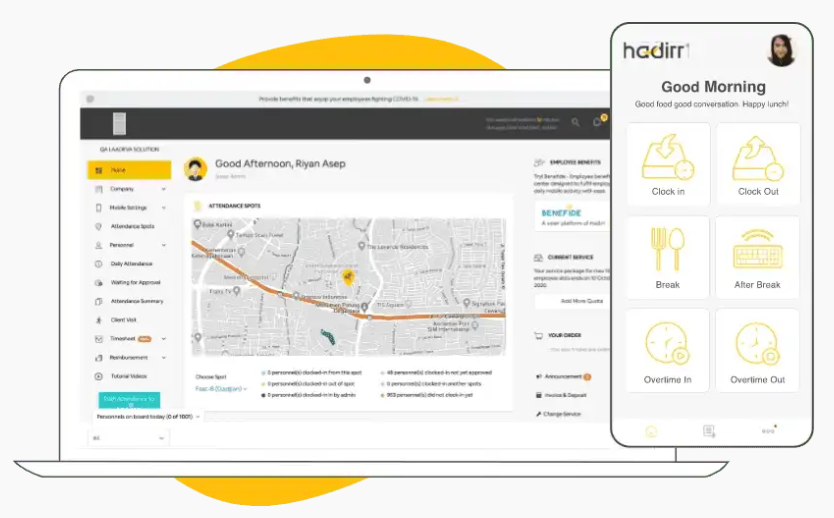
Everything starts with clock-in. When a worker arrives at a factory in Tangerang, GPS confirms the location. Facial recognition confirms the identity. The timestamp is locked in automatically—not edited later, not reconstructed at the end of the month.
When overtime comes in, it’s not just an extra entry. The request sits on top of actual, verified working hours. Managers see the full context before approving: when the shift started, how many hours have already been worked, and whether approving that request pushes the worker past legal limits.
One Workflow Across Different Countries
The same logic applies in Shah Alam and Singapore. Different regulations, same operational problem—and the same need for clean records. Every approved overtime session carries its own trail: timestamp, approver, linked attendance. Not something built after the fact. Something that already exists when auditors ask for it.
Catching Problems Before They Happen
Where this matters most is in messy, real-world scenarios. A last-minute absence forces a replacement. Someone needs to stay longer. Without visibility, supervisors approve first and check limits later—if they check at all.
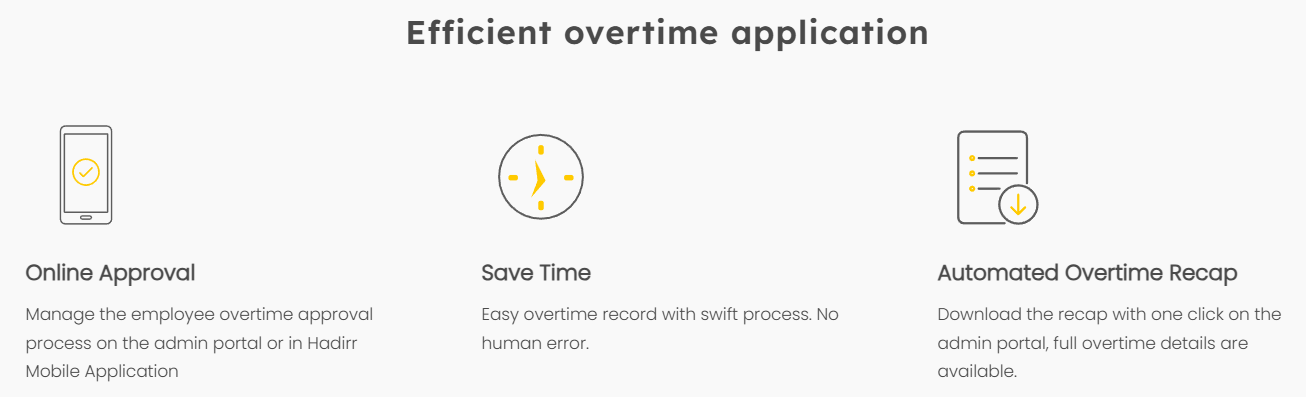
With Hadirr, overtime rules are configured in advance based on local labor regulations. Maximum hours, rest periods, and country-specific requirements are built into the system.
When supervisors assign additional hours, they do so with full visibility into each worker’s accumulated time—before the decision is finalized. This reduces the risk of unintentionally exceeding legal limits and keeps overtime within compliant boundaries from the start.
Built for Real-World Constraints
Even in environments where device ownership is inconsistent, the record stays clean. Workers can clock in using a shared device. Facial recognition ensures the data still maps to the right person. No duplicate entries. No guessing during payroll.
One Dataset, No Reconstruction
By the time payroll runs, there’s nothing to reconstruct. Timesheets are already built from verified data. Overtime calculations sit on top of records that match—attendance, approval, and payment all tied together.
For regional teams managing Indonesia, Malaysia, and Singapore at once, this removes the usual friction. No more reconciling separate logs, chasing approvals, or fixing mismatched data at month-end.
Just one dataset that holds up—whether it’s for payroll, internal review, or an external audit.
Also read: Sales Geofencing Malaysia to Prevent Fake Check-ins
The Right Tools to Track Overtime Start With the Right Foundation
Every tool on this list tracks overtime. The question worth asking is what your overtime data is actually built on.
Self-reported clock-ins produce overtime records that look clean. GPS-verified attendance produces overtime records that hold up—in payroll disputes or audits.
For SEA operations where the cost of getting it wrong includes ministerial formula disputes, Employment Act claims, and MOM scrutiny, the foundation is the difference that matters most.
When the audit comes, will your records hold up? See how Hadirr handles it—and decide for yourself.