

Multi-Site Attendance Tracking Software for HR Teams in SEA
Attendance tracking across multiple Southeast Asian (SEA) locations often gets treated as a minor operational detail. Ask any regional HR director responsible for it, and they’ll tell you it’s one of the most persistent headaches in the role.
Here’s a scenario that plays out in regional companies across SEA more often than most teams admit. The Jakarta office uses a fingerprint machine. Data gets exported to Excel at the end of each month. The Kuala Lumpur team uses a mobile attendance app—a different one from Jakarta, purchased independently by the local HR team two years ago. The Singapore office uses a badge system integrated with payroll. Every month, consolidating attendance data requires three HR staff, four working days, and a master spreadsheet that almost always contains at least one error.
When the Singapore regional HQ asks “how many people were present across all locations last Tuesday?”—nobody can answer in a single click. A compliance audit in Jakarta may request attendance records in a specific format, but that format doesn’t match what the KL system exports. And when a senior employee disputes their overtime calculation across two countries, the HR team spends two weeks reconstructing records from three systems that don’t talk to each other.
This is what attendance tracking actually looks like when it grows organically rather than by design. And it’s exactly the problem this article addresses.
Why Multi-Site Attendance Tracking Breaks Down Across SEA

Regional companies operating across Indonesia, Malaysia, and Singapore face three distinct layers of complexity that single-country HR teams never encounter simultaneously.
Three regulatory frameworks shaping attendance compliance in Southeast Asia
Singapore’s Ministry of Manpower (MOM) mandates specific record-keeping standards for working hours, overtime, and leave. Malaysia’s Employment Act 1955—updated with PDPA implications for location and biometric data—sets its own documentation requirements. Indonesia’s Labor Law requires attendance records that support overtime calculations under Government Regulation (PP) No. 35/2021.
None of these frameworks are identical. An attendance tracking system that satisfies MOM requirements in Singapore may not generate the documentation format expected by Indonesia’s Manpower Office. HR teams that use one system configured for one market and hope it covers the others only realise the gap when an audit or dispute forces the issue.
Different infrastructure realities affecting attendance tracking across Southeast Asia
Singapore operates with consistent, high-quality digital infrastructure. Malaysia’s urban centres match Singapore’s connectivity standards—but connectivity becomes inconsistent in industrial corridors and semi-rural areas. Indonesia’s infrastructure gap between Java and outer islands is significant—a mobile attendance system that works flawlessly in Jakarta may generate data gaps for teams in Makassar or Balikpapan.
Attendance tracking systems designed for the Singapore standard fail in Indonesian field conditions. Systems designed for Indonesian infrastructure variability may lack the integration sophistication that Singapore payroll systems require.
Diverse cultural reporting dynamics that shape how data gets recorded
Singapore’s professional culture is typically direct and documentation-conscious. Malaysian teams generally adapt to formal systems quickly when implementation is clear. Indonesian teams—particularly in smaller offices or field operations—bring high-context communication norms where reporting optimistically to superiors is a deeply ingrained professional reflex.
A regional HR team in Southeast Asia that interprets attendance data through one cultural lens across all three markets will consistently misread the data from at least one of them.
Also read: Best Remote Sales Monitoring and CRM Tools in Singapore
Six Best Practices for Multi-Site Attendance Tracking in SEA

These practices reflect what high-functioning regional HR teams implement—not in theory, but in actual multi-country operations across SEA.
1. Standardize the data model, not the tool
Regional teams often default to one tool for every location—and that’s where things start to break down. Tools that work for Singapore’s badge-integrated payroll may fail in Indonesian field conditions. Instead, standardize what the data must contain—employee ID, timestamp, location verification, break records, overtime flags—and allow location-appropriate tools that output to a consistent format. Central consolidation becomes possible without forcing operational uniformity.
2. Build attendance tracking compliance requirements into the system architecture, not the reporting layer
Every location’s attendance system must capture data in the format that local labor law requires—from day one. Retrofitting compliance documentation after a dispute or audit is significantly more expensive than building it in. For Indonesia, this means overtime-eligible records with ministerial formula compatibility. In Malaysia, it requires PDPA-proportionate location data with proper consent documentation. In Singapore, working hours records must align with MOM requirements.
3. Separate attendance verification from attendance reporting
Verification confirms that an employee was present at a specific location and time. Reporting, on the other hand, summarises attendance patterns for HR and management. Verification requires GPS validation, facial recognition, or biometric confirmation. Reporting requires aggregation, formatting, and comparison across locations. Systems that handle both well are rarer than most vendors would have you believe.
4. Design for the lowest-connectivity location in your network
If your operation includes any location in Indonesia outside of Java—or any field-based team anywhere in the region—design your attendance tracking architecture for offline-first capability. Systems that require continuous connectivity create data gaps in exactly the locations where data integrity matters most. Offline logging with automatic background sync is the only architecture that produces reliable data across the full geographic spread of a SEA operation.
5. Establish a single consolidation point with role-based access
Regional HR needs consolidated visibility. Local HR needs location-specific data. Operational managers need their team’s data. A multi-site attendance system must support all three simultaneously through role-based access controls—without requiring manual data extraction and combination at each reporting cycle. The regional director should be able to access cross-location attendance data from a single dashboard, without relying on manual consolidation.
6. Audit the data regularly, not just the system
Most regional companies audit their attendance system setup once—at implementation—and then assume the data it produces remains accurate. In practice, data quality degrades over time as workarounds accumulate, staff turnover changes how the system gets used, and location-specific adaptations diverge from the original configuration. Quarterly data audits—comparing system records against payroll outputs, leave balances, and local manager observations—catch drift before it becomes a dispute.
Also read: Top Sales Management Software for Indonesian Businesses
The Compliance Layer: What Attendance Tracking Must Satisfy in Indonesia, Malaysia, and Singapore

HR teams in SEA need a working understanding of what each country’s labor framework requires from attendance records. This isn’t a legal guide—but it’s what most HR teams end up needing when configuring their systems.
Indonesia: Attendance records must support overtime calculations under the formulas specified in PP No 35/2021. Records must be verifiable—and ready for a Manpower Office audit or a legal dispute.
The Undang-Undang Perlindungan Data Pribadi (PDP Law) classifies location data and biometric data as personal data requiring explicit consent and proportionate processing. Attendance systems using multi-location GPS tracking or facial recognition must operate within UU PDP parameters.
Malaysia: The Employment Act 1955 requires employers to maintain wage records, working hours, and overtime documentation. The Personal Data Protection Act 2010—with 2024 amendments strengthening enforcement—governs how employee location and biometric data is collected, stored, and accessed. Attendance tracking that operates outside working hours, or without proper employee notice and consent, creates PDPA exposure regardless of operational intent.
Singapore: The Employment Act requires employers to maintain records of employees’ working hours, overtime hours, and leave for at least two years. MOM’s record-keeping requirements specify the format and retention period. Singapore’s Personal Data Protection Act (PDPA) governs biometric data processing—facial recognition at clock-in requires informed consent and purpose limitation documentation.
The practical implication for HR teams in Southeast Asia: a single attendance tracking system deployed across all three countries must be configurable for each country’s consent requirements, data retention rules, and record format expectations—not just functionally capable of recording attendance.
Also read: Sales Geofencing Malaysia to Prevent Fake Check-ins
How Hadirr Supports Multi-Site Attendance Tracking Across SEA

Hadirr is built for exactly this kind of regional complexity—where attendance data doesn’t live in one country, one system, or one format. It creates a single, consistent layer across Indonesia, Malaysia, and Singapore—while still adapting to how each location actually operates.
Unified Dashboard, Location-Specific Data
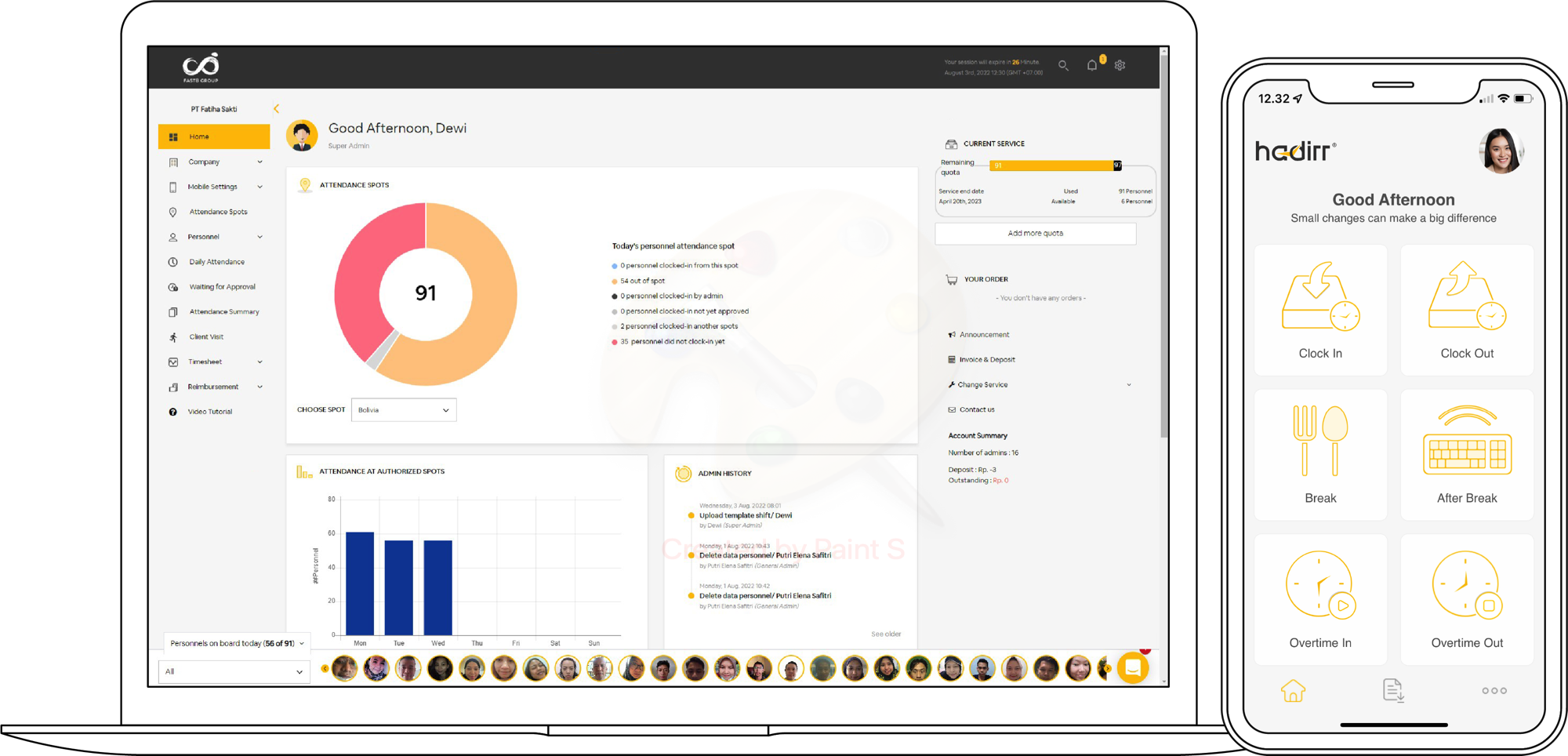
Hadirr’s mobile attendance feature gives regional HR teams a single dashboard that shows real-time attendance across every location. The Jakarta team, the Kuala Lumpur team, and the Singapore team all appear in one consolidated view. Managers drill down by location, by team, or by individual. The regional director who needs cross-location attendance data gets it in one click. That “how many people were present last Tuesday?” question—gets answered instantly.
Each location operates with GPS geofencing configured for its specific approved zones—offices, warehouses, client sites, or field territories. Facial recognition confirms identity at clock-in. Every record carries a timestamp and a verified location—the foundation that makes mobile attendance tracking data defensible across all three compliance environments.
Designed for SEA Infrastructure Variability
Hadirr’s mobile-first architecture handles Indonesia’s connectivity variability—offline logging with automatic sync ensures that a field rep in Surabaya or a warehouse team in Batam generates complete attendance records regardless of signal quality. The same system operates seamlessly in Singapore’s high-connectivity environment without configuration changes.
For teams with employees who don’t own reliable personal devices—more common in Indonesian operations than regional HQ teams typically expect—Hadirr’s Lend App feature allows attendance recording through a colleague’s device, with facial recognition tying the record to the correct employee identity.

Overtime and Timesheet Integration
Attendance data flows directly into overtime management and timesheet generation—automatically, without manual extraction. Overtime requests route through digital approval workflows. Timesheets generate from verified attendance records rather than self-reported summaries.
For HR teams managing payroll across three countries, this eliminates the monthly reconciliation exercise that consumes disproportionate HR bandwidth. The data is clean at source. The timesheet reflects what actually happened. Compliance documentation exists before anyone asks for it.
Hadirr supports thousands of companies across the region—from small representative offices to larger organisations managing hundreds of field staff. The platform handles SEA’s regulatory and infrastructure diversity because it was built for it.
Also read: Tapping into Indonesia’s Special Economic Zones Advantage
The Regional Standard Worth Building Toward

Attendance tracking across multiple sites in Southeast Asia doesn’t become easier as operations grow. It becomes more complex—more locations, more compliance requirements, more data that needs to be consolidated, compared, and acted on.
Regional HR teams that build the right system early—one that standardizes data across locations, satisfies each country’s compliance requirements, and gives central HR visibility without creating local operational friction—compound that investment over time. Every new location added to a well-designed system costs less to integrate than the previous one.
HR teams in SEA that let attendance tracking grow organically—one tool per country, one workaround per quarter—pay a different kind of compound interest. The data gets harder to consolidate. The compliance gaps get harder to retrofit. The disputes get more expensive to resolve.
The right attendance software for Southeast Asian operations isn’t the one that works in Singapore. It’s the one that works across Singapore, Malaysia, and Indonesia—and makes regional HR’s job simpler rather than more fragmented.
If your regional team is still consolidating attendance data manually, it may be time to rethink the system behind it. Hadirr offers a simpler way to bring visibility across every location—without adding complexity at the local level.