
How to Track Sales Team Performance Outside the Office for Better Coaching
A sales manager at a pharmaceutical distribution company in Petaling Jaya knows exactly how to track sales team performance outside the office. She has a dashboard. Visit counts per rep, attendance records, pipeline stages, territory coverage maps. Every Monday morning she reviews the numbers before her team check-in call.
And every Monday morning, the coaching conversation goes the same way it did before she had any of this data.
“Aiman, your numbers are down this month. What’s happening?”
Aiman gives an explanation. She listens. She encourages him to push harder. The call ends. Next Monday, same conversation, different name.
The data is there. The coaching hasn’t changed. And that gap, between having performance visibility and actually using it to improve coaching, is where most Malaysian sales managers live, regardless of what tracking tools they’ve implemented.
The Gap Between Tracking and Coaching

Tracking tools solve the data collection problem. They don’t automatically solve the interpretation problem.
Activity metrics such as visit counts, check-in times, and pipeline entries tell managers what happened. They don’t tell managers what it means, what’s driving it, or what should change. A rep who completed 40 visits last month and converted 3 deals is generating the same visit count as a rep who completed 40 visits and converted 12 deals. The number looks identical. The performance is completely different.
Knowing how to track sales team performance outside the office at the activity level is the starting point, not the destination. The goal is understanding which activities drive commercial outcomes, which reps need different support, and what specific changes will improve performance.
Malaysian sales managers who stop at activity monitoring have better data than before. They don’t have better coaching conversations. Those require a different layer of analysis, one that connects activity inputs to commercial outputs and surfaces the patterns that explain performance differences between reps.
This gap between activity visibility and performance understanding is where most field sales performance tracking Malaysia implementations plateau. The tools are running. The data is accumulating. The coaching is still happening by intuition and impression rather than by evidence.
Also read: Multi-Site Attendance Tracking Software for HR Teams in SEA
How Field Sales Performance Differs Across Malaysia

Understanding field sales performance in Malaysia requires recognising that performance looks different across different operating environments. Managers learning how to track sales team performance outside the office effectively must account for those differences before comparing rep output across territories.
Klang Valley field sales: high visit density, relationship-driven closing
A field rep covering Klang Valley manages the highest client density in Malaysia. Between distributors in Petaling Jaya, warehouses in Shah Alam, and retail accounts in Subang Jaya, a rep might cover 15 client touchpoints in a relatively compact geographic area within a single day.
Outside office sales monitoring in this context must track visit sequence and duration, not just visit count. A rep who spends 45 minutes at a key account has a fundamentally different day than one who drives past 8 accounts doing 5-minute check-ins. Both generate 8 visits on the report.
Johor and Iskandar Malaysia: cross-border dynamic and two-market pressure
Johor field sales teams often operate with awareness of Singapore market comparisons: clients who know what competitors charge across the causeway, buyers who have more options than their counterparts in other Malaysian states.
Field sales performance tracking Malaysia in Johor must account for longer sales cycles in certain categories, different price sensitivity, and the competitive dynamic that affects conversion rates regardless of rep effort.
East Malaysia: distance, relationship depth, and infrequent visits
Sabah and Sarawak field sales operate under constraints that Peninsula Malaysia managers consistently underestimate. Travel time between client locations consumes hours that Klang Valley reps spend on additional visits.
Relationship investment per client is higher because visit frequency is naturally lower. A rep in Kota Kinabalu who makes 8 visits per week may be significantly more productive than a rep in KL making 20, but standard field sales KPI tracking Malaysia systems that measure visit count as the primary metric will score the Kota Kinabalu rep as a lower performer.
Understanding these contextual differences is prerequisite to useful coaching. A manager who applies Klang Valley performance benchmarks to an East Malaysia team is comparing incomparable situations, and coaching toward the wrong targets.
Also read: Sales Geofencing Malaysia to Prevent Fake Check-ins
Four Questions That Reveal Real Sales Team Performance

These four questions cut through activity data to reveal the performance patterns that coaching conversations should address. For managers learning how to track sales team performance outside the office effectively, the challenge is not collecting more data, but understanding what the data actually means. If managers cannot answer all four using their current tracking system, they have visibility without insight.
Question 1: What is each rep’s visit-to-outcome conversion rate, and how has it changed over the past three months?
Visit count tells you effort. Visit-to-outcome conversion tells you effectiveness. A rep whose conversion rate is declining despite stable visit counts is having less productive conversations, not working less hard. The coaching conversation for that rep is completely different from the conversation for a rep whose conversion rate is stable but visit count has dropped.
Sales rep performance tracking that surfaces trends rather than just monthly snapshots allows managers to catch declining effectiveness before it becomes a pipeline problem. The conversation shifts from “why are your numbers down?” to “I notice your conversion rate has dropped over three months while your visit count stayed the same, let’s talk about what’s happening in those meetings.” That’s a fundamentally more useful coaching conversation.
Question 2: Which accounts are being visited consistently, and which are being avoided?
Every sales rep has accounts they gravitate toward: established relationships, easy conversations, predictable outcomes. And accounts they avoid: difficult buyers, complex objections, long sales cycles. Sales activity monitoring across Malaysian field teams often reveals this avoidance pattern clearly.
A rep who visits the same 12 accounts repeatedly while 20 accounts on their territory list haven’t been touched in 6 weeks isn’t underperforming on visit count. They’re underperforming on territory coverage. The coaching conversation isn’t about effort. It’s about account selection strategy.
Question 3: How long are reps actually spending at client sites, and does duration correlate with outcomes?
Visit duration is one of the most underused performance metrics in Malaysian field sales. A 15-minute visit and a 60-minute visit generate the same check-in record in most tracking systems. But in complex B2B sales, duration often correlates strongly with engagement quality and conversion likelihood.
Outside sales performance metrics that include visit duration allow managers to identify reps who are physically present at accounts without having substantive conversations, and to coach toward deeper engagement rather than just more visits.
Question 4: Where does the pipeline stall, and is the stalling point consistent across reps or specific to individuals?
Pipeline stage progression data reveals whether performance problems are systemic or individual. If deals consistently stall at the same stage across the entire team, the issue is likely the sales process, the script, or the market itself, not an individual rep’s performance. If deals stall at different stages for different reps, the problems are individual and require targeted coaching.
A sales performance dashboard that shows pipeline distribution by rep and by stage gives managers the diagnostic data to distinguish systemic problems from individual ones, and to coach accordingly.
Also read: Field Sales Software for Malaysian SMEs: Stop Guessing, Start Tracking
Building a Tracking System That Supports Coaching, Not Just Monitoring

The tracking system that enables better coaching has three characteristics that pure monitoring systems often lack. Managers trying to understand how to track sales team performance outside the office effectively often discover that collecting activity data is the easy part. Turning that data into useful coaching insight is much harder.
It captures quality signals, not just activity counts
Visit count is a quantity metric. Visit duration, client signature capture, documented follow-up actions, and stage progressions are quality signals. A field sales tracking system that captures both gives managers the full picture: how much activity is happening and how productive that activity is.
This requires a field sales app that reps actually use in real time. Quality signals only exist when reps document visits as they happen, not through retrospective end-of-day logs. An app that makes visit documentation fast enough to complete in a parking lot gets quality data. An app that reps batch-log on Friday afternoon gets activity counts.
It surfaces trends, not just snapshots
A single month’s data point is a fact. Three months of data points is a pattern. The coaching conversations that change behaviour are grounded in patterns: “I’ve noticed over the past 12 weeks that your conversion rate in new accounts is significantly lower than in existing accounts. Let’s talk about what’s happening in first and second meetings.” That conversation requires trend data, not just the current month’s numbers.
Remote sales team performance tracking in Malaysia that stores historical data and surfaces trends, rather than just displaying the current period, gives managers the longitudinal view that meaningful coaching requires.
It connects individual activity to team and territory context
A rep’s performance is partly a function of their skills and effort, and partly a function of their territory, their account mix, and their market conditions. Coaching that ignores context misattributes performance. A system that allows managers to compare rep performance within similar territory and account conditions surfaces genuine skill gaps rather than just circumstantial performance differences.
Also read: Stop Client-Site Fraud with Geofencing Client Solutions in Malaysia
How Hadirr Gives Malaysian Sales Managers the Data They Need to Coach

Hadirr is built around one operational reality: managers cannot coach from data they don’t trust. For companies trying to understand how to track sales team performance outside the office, trustworthy data only exists when activity is captured in real time from verified sources, not reconstructed from memory at end of day.
The attendance baseline that makes everything else credible
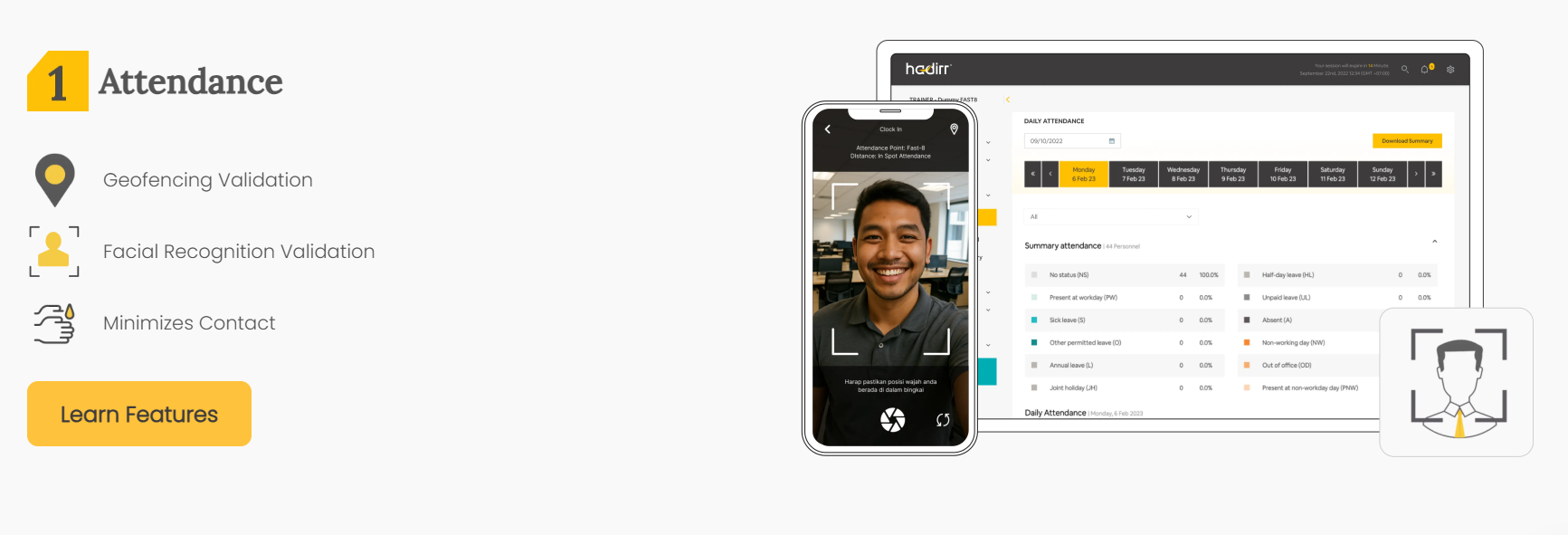
When a rep clocks in from a client site in Petaling Jaya, GPS geofencing and facial recognition verify both location and identity in one step, before the meeting starts. For coaching purposes, attendance patterns become the first performance signal worth watching.
A rep whose start times have drifted by an average of 20 minutes over three months is showing a pattern that warrants a conversation before it affects pipeline outcomes. When that data comes from verified GPS records rather than self-reported check-ins, the manager can reference it in a coaching conversation without the rep being able to dispute the record. The conversation stays focused on performance, not on debating whether the data is accurate.
Visit documentation that changes what coaching sounds like
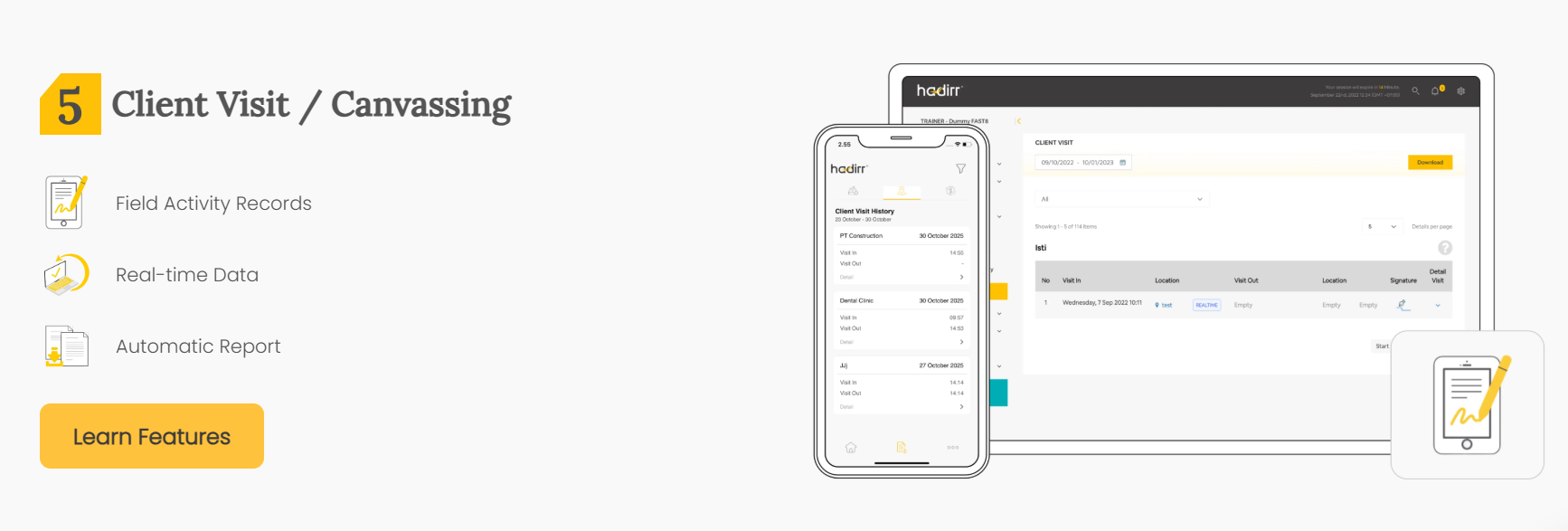
The visit documentation that used to live in a rep’s memory, or not at all, generates automatically at every client interaction: GPS location, visit duration, digital signature, meeting notes, follow-up actions. All captured in under two minutes, before the rep reaches their car.
For Malaysian sales managers, this changes what coaching sounds like. Instead of a “how did your meetings go?” question that invites self-reporting, the conversation becomes: “I can see you spent an average of 18 minutes at new accounts this week versus 42 minutes at existing ones. Tell me what’s happening in those shorter meetings.”
That question, grounded in documented data, generates a completely different quality of coaching dialogue. The manager isn’t guessing. The rep isn’t defending an impression. Both are looking at the same verified record and discussing what it means.
For sales activity monitoring Malaysia that includes territory coverage patterns, this visit documentation also reveals the avoidance behaviour that activity counts hide: which accounts are being skipped, which relationships are being neglected, and where coaching should focus to improve coverage discipline.
Pipeline connection that reveals where performance actually breaks down
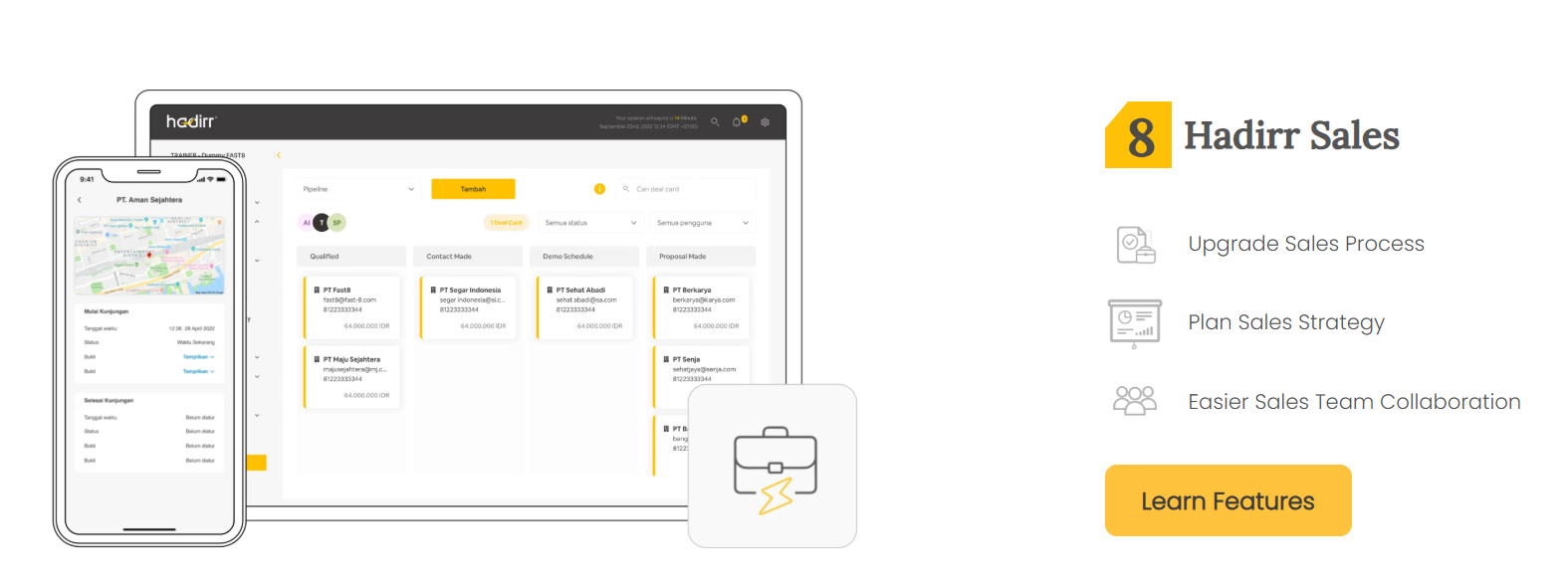
Every documented visit feeds directly into customer records and deal stages, connecting field activity to pipeline movement without requiring reps to update a separate CRM after the fact. Managers see which visits moved deals forward and which didn’t.
The coaching question shifts from “are you making enough visits?” to “your visit count is strong, but deals in negotiation have stalled for three weeks, let’s look at what’s happening in those accounts.” The data exists. The conversation can be specific.
For managers handling remote sales team performance in Malaysia, especially those who rarely share physical space with their teams, this pipeline visibility converts weekly check-in calls from status updates into genuine coaching conversations: grounded in evidence, specific to the rep’s actual performance patterns, and focused on the changes that will move commercial outcomes.
Together, verified attendance, quality visit documentation, and pipeline stage progression give Malaysian sales managers what most outside sales performance metrics systems cannot: not just visibility into what field teams are doing, but insight into what’s driving performance differences and what specific coaching interventions are most likely to move the numbers.
More than 10,000 companies across Southeast Asia use Hadirr to manage their sales teams across industries including FMCG, pharmaceuticals, manufacturing, property, and financial services.
Also read: How to Track Field Sales in Malaysia Without Violating PDPA
Data That Earns Its Dashboard
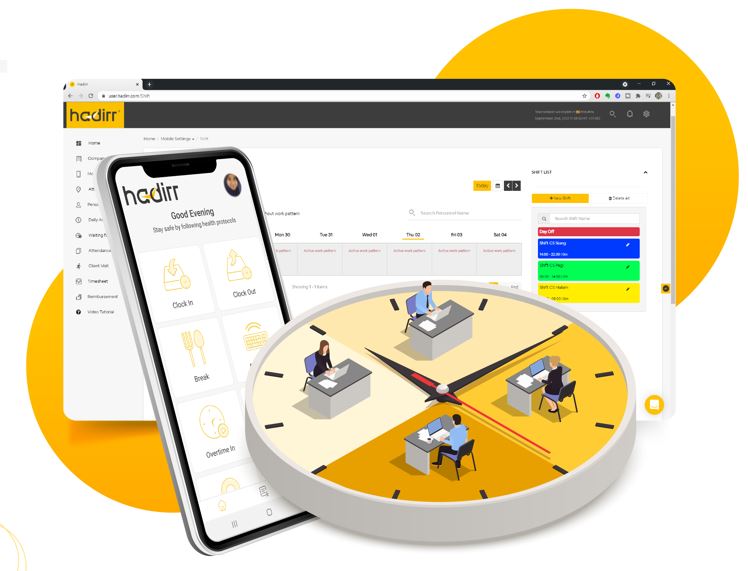
The best performance tracking system is the one that changes what happens in the coaching conversation, not just what appears on the dashboard.
Malaysian sales managers who know how to track sales team performance outside the office have solved half the problem. The other half is using that data to have coaching conversations that are specific, evidence-based, and connected to the actual drivers of commercial performance in their team’s particular market context.
That requires tracking systems that capture quality alongside quantity, surface trends alongside snapshots, and connect field activity to pipeline outcomes in one verified data set.
When those elements are in place, the Monday morning conversation changes. Not: “Aiman, your numbers are down, what’s happening?” But: “Aiman, your visit count is strong, but your conversion rate in new accounts has dropped for three straight months, and your average visit duration with new contacts is significantly shorter than with existing clients. I want to understand what’s happening in those first meetings.”
That’s a coaching conversation grounded in data. That’s what the right tracking system makes possible.
Turn field sales data into better coaching conversations. Explore Hadirr and give your sales managers the visibility they need to coach with evidence, not intuition.