
Why Your Sales Pipeline Doesn’t Match Reality
Every Malaysian sales director has lived this moment. The sales pipeline looks healthy in October. Deals are moving. Stages are progressing. The forecast says the quarter closes strong.
Then November arrives and the numbers collapse. Three hot deals go cold. Two accounts that were in negotiation haven’t been contacted in six weeks. One rep left the company and took all the relationship context with them.
The pipeline did not fail at the end. It was never accurate to begin with.
Most Malaysian SMEs treat the sales pipeline as a reporting tool, something that tells management what happened. The businesses that consistently hit their numbers treat it differently. They use it as a decision-making tool, something that tells them what to do next.
That shift in purpose requires a fundamentally different approach to how pipeline data gets captured, maintained, and acted on.
This article is about that difference.
The Four Ways Malaysian Sales Pipelines Lose Their Accuracy

Pipeline inaccuracy in Malaysian SMEs rarely comes from dishonesty. It comes from four structural problems that compound quietly until a quarter closes badly.
Optimistic stage tagging
Sales reps in Malaysia, like others everywhere, are optimists by temperament and incentive. A deal with one positive meeting gets tagged proposal stage. A client who said “send me more information” gets tagged qualified. These optimistic tags feel accurate at the time. Across 20 deals and four reps, they produce a sales pipeline that consistently overestimates near-term revenue by 30 to 50 percent.
The problem is not the reps. The problem is that stage definitions mean different things to different people. Without shared criteria for what negotiation actually requires, such as specific actions, documentation, and buyer signals, pipeline stages reflect rep sentiment, not commercial reality.
WhatsApp deals that never enter the system
For Malaysian sales teams, most relationship-building and deal progression happens in WhatsApp threads. A distributor in Johor Bahru says “let’s move forward” in a chat message. A buyer in Penang commits to a pilot project verbally during a teh tarik. None of this enters the CRM pipeline because entering it requires effort that the conversation’s natural flow never pauses for.
The result: the pipeline shows the deals that got entered, not the deals that exist. The gap between those two numbers is where Malaysian sales forecasts consistently fail.
Rep turnover that deletes relationship history
Malaysia’s sales job market moves fast. When a rep leaves, the WhatsApp conversations, the relationship context, the informal commitments, and the understanding of each account’s actual status leave too. The CRM record that remains shows stage tags and call logs. It does not show that the buyer in Shah Alam only buys from people she trusts, that the last meeting ended awkwardly, or that the deal was actually closer than the stage tag suggests.
Pipeline accuracy in Malaysia depends on capturing relationship context, not just transaction stages. Most systems capture stages. Almost none capture context.
Stage movement without verified activity
The most subtle form of pipeline inaccuracy is stage progression that happens on paper without corresponding field activity. A deal moves from qualified to proposal sent because a rep updated the stage, not because a proposal was actually delivered and discussed with the client. A deal stays in negotiation for nine weeks because nobody wants to mark it as stalled.
Sales pipeline tracking systems that require manual stage updates create this problem by design. When updating a stage costs time and carries no immediate benefit for the rep, updates happen infrequently, optimistically, and without verification.
Also read: Best CRM Software in Malaysia for SMEs (2026 Guide)
What a Reliable Sales Pipeline Actually Measures

A sales pipeline that supports decision-making measures three things simultaneously. Most Malaysian pipelines measure only one.
Activity quality, not just activity volume
Visit count is a pipeline input. What happened during those visits, including their duration, client feedback, commitments made, and next steps, provides a strong signal of pipeline quality. A rep who made 15 visits and documented each one with meeting notes, client signatures, and follow-up actions has generated 15 data points that management can act on. A rep who made 15 visits and logged them as check-ins has generated 15 numbers that tell management almost nothing.
Relationship depth, not just deal stage
The deals that close reliably in Malaysian B2B and distribution sales close because relationships are strong enough to support a commercial decision. Field sales pipeline management captures relationship history, including who reps met, how often they met, what they discussed, and the quality of the relationship. That information gives sales managers the diagnostic data that stage tags cannot provide.
A deal in negotiation with 15 documented visits over three months tells a completely different story from a deal in negotiation with one visit logged four months ago. The stage tag is the same. The commercial reality is not.
Commercial velocity, not just current position
Pipeline position tells you where deals are. Pipeline velocity tells you how fast they are moving and whether that speed is consistent with the deal type, the relationship stage, and the historical conversion patterns for similar accounts.
Sales forecasting Malaysia that treats all deals in the same stage as equivalent misses the velocity signal entirely. A deal that moved from first contact to proposal in three weeks is on a fundamentally different trajectory from one that has been in proposal for ten weeks. Both appear identically in a static pipeline view. Only a system that captures timestamped activity can show the difference.
Also read: How to Track Field Sales in Malaysia Without Violating PDPA
Building a Sales Pipeline That Malaysian Field Teams Will Actually Maintain
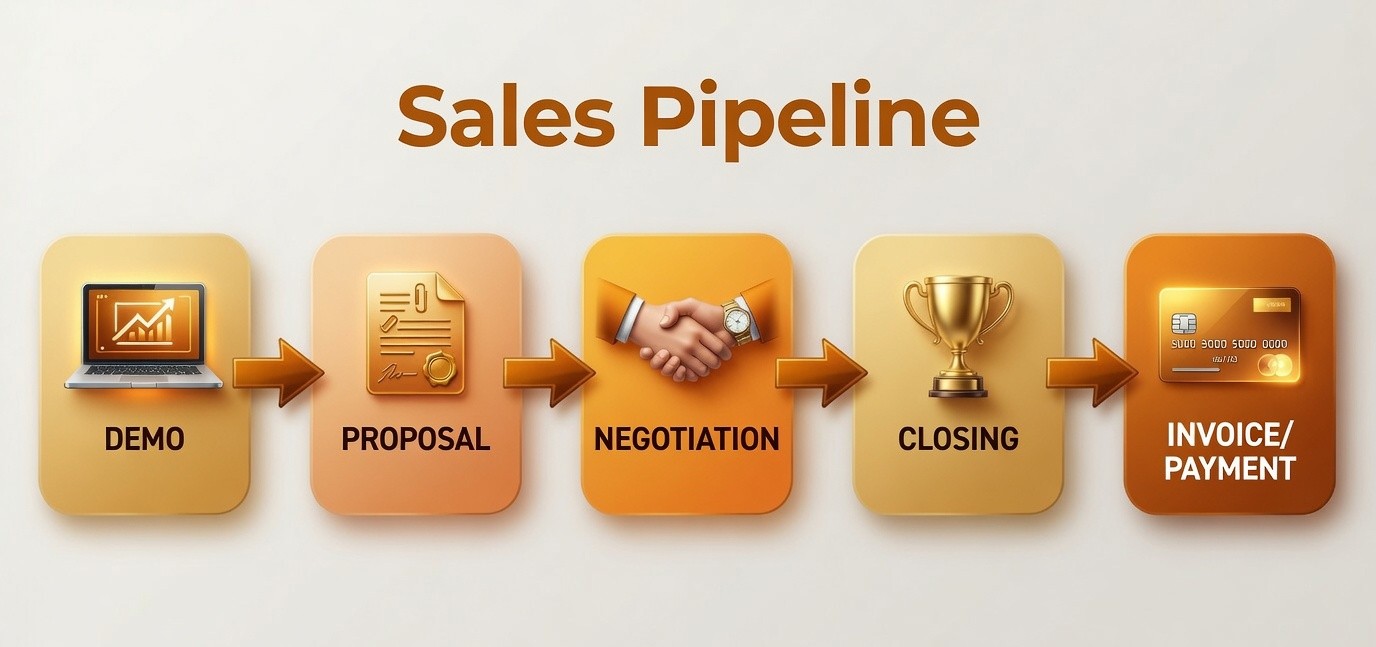
The most common pipeline failure in Malaysian SMEs is not strategic. It is practical. Reps do not maintain pipeline data because maintaining it costs time they do not have and delivers benefits that accrue to management, not to them.
Fixing this requires designing the pipeline around the rep’s workflow, not around the manager’s reporting needs.
Make the update happen at the visit, not after it
A rep who completes a visit log while still at the client’s location is far more likely to record accurate information. A rep who plans to update the CRM later often postpones it until Friday afternoon, relying on memory that becomes less reliable with each passing day.
Effective sales pipeline management removes that delay. Reps complete GPS confirmation, meeting notes, digital signatures, and follow-up actions on their phone before leaving the site. When documentation takes less than two minutes, adoption becomes a natural part of the visit rather than an administrative task that gets pushed aside.
Give reps something the pipeline gives back to them
Reps update the pipeline consistently when it helps them do their job. A pipeline management system for Malaysian SMEs that surfaces each rep’s client history before every visit turns pipeline data into a useful sales resource rather than an administrative task. Their pipeline data becomes a preparation tool, not just a reporting obligation.
Define stages by actions, not by sentiment
Qualified means the rep has documented a specific budget signal, a specific decision-maker conversation, and a specific timeline. Not “I think they’re interested.” Stage definitions that require documented evidence before a deal advances eliminate optimistic tagging at the source. The pipeline reflects verified commercial progress, not rep confidence.
Connect pipeline to incentive calculations
In Malaysian sales teams where incentive disputes are common, a verified pipeline record protects the rep as much as it informs management. A rep whose incentive calculation is based on documented, GPS-verified visit activity and pipeline progression has no motivation to dispute the numbers, because the numbers came from their own activity. That alignment of interest produces the most reliable pipeline data of all.
Also read: Field Sales App: Improve Adoption, Visibility, and Team Performance
How Hadirr Keeps Malaysian Pipelines Honest

Most pipeline inaccuracies begin with missing field activity, delayed updates, or incomplete visit records. Hadirr Sales addresses those issues at the source by connecting every customer visit directly to the pipeline.
Real-Time Field Activity Creates an Honest Pipeline
Most pipeline problems surface at month end. Hadirr surfaces them the moment they happen.
When a rep visits an account in Shah Alam and the meeting goes sideways, that signal enters the pipeline immediately. The rep logs what happened, what the client said, and what changed. The stage reflects the actual commercial position. Not what the rep hoped would happen. Not what they entered three weeks later from memory.
That immediacy is what makes the pipeline honest.
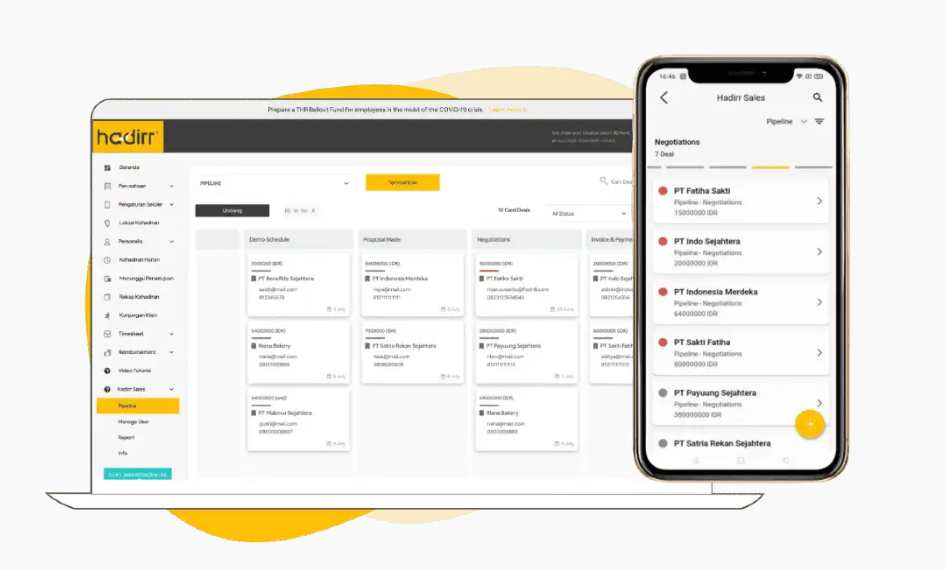
Hadirr Sales connects every documented visit to a specific deal stage. The pipeline stage does not advance until the visit confirms it should. A deal stays in proposal until the rep documents a client response. A deal moves to negotiation when the rep records a verified buyer signal, not when they feel optimistic about it.
From Visit Documentation to Pipeline Visibility
For the sales manager reviewing accounts on a Wednesday morning, this produces a fundamentally different pipeline. A sales deal tracking system built on verified visits reveals accounts that look active but have had no contact in 40 days. It surfaces deals where visit frequency is high but stage progression is zero. It shows which reps document follow-up commitments and which ones log check-ins with no next step.
Those patterns are invisible in a manually updated pipeline. They are immediately visible in one built from real field activity.
Better Data Creates Better Sales Coaching
The coaching conversation that follows is different too. Not “why are your numbers down?” but “this account had six visits in eight weeks with no stage movement. Walk me through what happens in those meetings.” The data makes the question specific. The rep cannot deflect with a general explanation.
Pipeline visibility built on verified field activity does one thing that no amount of manual discipline can match: it makes the gap between activity and progress impossible to hide. The deals that are genuinely moving look different from the ones that are stuck. The manager who can see that difference in real time manages with evidence, not with intuition.
Among 10,000+ businesses using Hadirr across Southeast Asia, the field sales teams and distribution networks that maintain the most reliable pipelines share one characteristic: their reps document visits in real time because the system makes it faster than not doing it.
Also read: Best Shift Scheduling Software for SEA Operations Teams
The Pipeline That Tells the Truth
A sales pipeline managers trust changes everything downstream. Forecasts become defensible. Coaching becomes specific. Territory decisions become evidence-based. Incentive disputes disappear because the numbers came from verified activity.
The Malaysian businesses that get this right do not have more disciplined reps. They do not have more rigorous managers. They have systems that make accurate data capture the path of least resistance. The visit log happens in the car park. Not at the end of the week. The pipeline reflects the commercial reality of every relationship the team builds.
That pipeline does not lie. It cannot. The data came from the field, at the moment it happened, verified by GPS and confirmed by the client’s signature.
See what your pipeline looks like when every visit gets documented in real time. Try Hadirr Sales and discover which deals are actually moving and which only look active on paper.