
Field Sales App: Improve Adoption, Visibility, and Team Performance
Three months after implementing a field sales app, a sales director at a consumer goods distributor in Shah Alam pulled the usage data. The adoption rate was 34%. The remaining 66% of reps were still logging visits from memory at end of day, still checking in via WhatsApp, still updating the pipeline from a desktop on Friday afternoon when nobody was looking. The field sales app existed. It was technically deployed. It was delivering almost nothing.
The problem wasn’t the features. The problem was that the app was designed to give management visibility, and reps knew it. Every check-in felt like reporting to a supervisor. Every visit log felt like submitting evidence. The app added work to an already full day without giving reps anything in return. So they used it as little as possible, which meant the data management needed was incomplete, which meant the visibility the company paid for never materialised.
This is the adoption trap that most field sales app implementations fall into, and it’s the problem this article addresses.
The Adoption Problem Nobody Talks About When Selling Field Sales App

Every field sales app vendor leads with management features: real-time rep tracking, visit verification, pipeline dashboards, territory analytics. These are legitimate capabilities that deliver genuine value. But they’re all framed from the manager’s perspective: what management can see, what management can measure, what management can control.
The field rep’s perspective is almost never part of the conversation.
A field sales rep in Malaysia typically covers five to ten client visits per day. Between visits, they’re driving, parking, navigating, and preparing for the next conversation. They’re managing their own schedule, responding to client messages, and handling whatever comes up unexpectedly. Their phone is a working tool, not an administrative terminal.
When a field sales app adds friction to that reality, such as requiring multi-step check-ins, demanding detailed logs between visits, timing out and requiring re-login, reps make a rational decision: do the minimum required to stay compliant, then update properly later. “Later” usually means Friday afternoon, from memory, with inevitable gaps and approximations.
The data that reaches management is technically complete and practically unreliable. The app has been adopted in form but not in function.
The field sales app that achieves genuine adoption solves this problem at the design level. It gives reps something valuable, not just a reporting obligation. Speed, clarity, context at the moment they need it. When using the app makes the rep’s day easier rather than harder, adoption follows naturally. And when adoption is genuine, the data that flows to management is accurate, complete, and trustworthy.
Also read: Sales Geofencing Malaysia to Prevent Fake Check-ins
What a Field Sales App Should Deliver for the Rep, Not Just for Management

Rethinking field sales tracking apps in Malaysia starts with a simple question: what does the rep actually get from using this app?
If the honest answer is “nothing, it just helps management track them,” adoption will always be low and data quality will always be poor.
If the answer is “they get faster visit logging, client history at their fingertips, a clear picture of where their pipeline stands, and documentation that protects them in incentive disputes,” adoption becomes a rational choice rather than a compliance obligation.
Here’s what a field sales app should deliver at the rep level.
Visit logging that takes seconds, not minutes
A rep arriving at a client office in Petaling Jaya has 30 seconds before walking into the meeting. The visit log needs to happen in that window or it won’t happen until much later, from memory. Sales visit tracking Malaysia apps that reduce the clock-in and visit initiation process to a single tap with automatic GPS capture and minimal required fields get used in real time. Apps that require five fields and a photo before accepting a check-in get logged retroactively.
Client history accessible before the meeting starts
The most valuable thing a field rep can have walking into a client meeting is context: what was discussed last time, what was promised, what the current pipeline stage is, what the client’s purchase history looks like. A mobile CRM for field sales that surfaces this information instantly, without requiring navigation through multiple screens, makes reps more effective in every conversation. That effectiveness is something reps notice and value.
Pipeline clarity without desktop access
Field reps who can see exactly where each account stands in the pipeline from their phone, between visits, make better decisions about where to invest time. Which accounts need a follow-up call today? Which deals are stalling and need a different approach? A sales pipeline app used by Malaysia teams that answers these questions from the mobile interface gives reps the strategic clarity that used to require a laptop and a quiet office.
Visit documentation that protects rep interests
In Malaysian sales teams where incentive calculations depend on verified visit activity, a GPS-verified visit log with a client signature protects the rep as much as it protects the company. When incentive disputes arise, the rep who can produce timestamped, GPS-verified visit records with digital client signatures has documentation that self-reported logs cannot match. This is something reps genuinely value once they understand it.
Also read: How to Track Field Sales in Malaysia Without Violating PDPA
The Field Sales App Features That Drive Real Adoption in Malaysian Teams

Malaysian field sales reality has specific characteristics that determine which features drive adoption and which ones create resistance.
Offline capability for area with poor connectivity
A field force app in Malaysia that requires continuous connectivity fails every rep who visits industrial areas in Selangor, manufacturing clusters in Johor, or any client outside major urban centres. Malaysian field teams operate across connectivity ranges that no Singapore-designed app accounts for. Offline logging with automatic sync isn’t an additional feature. It’s the feature that determines whether reps trust the app in the field or abandon it when signal drops.
Single-screen visit completion
The visit workflow that drives adoption completes on one screen: clock-in with automatic GPS, client name selection, meeting notes, digital signature request, follow-up action. Everything needed to document a complete visit, captured in under two minutes, without leaving the app or switching contexts. Sales activity app Malaysia tools that fragment this workflow across multiple screens lose reps at the second screen.
Automatic rather than manual data entry
Every field that populates automatically, including GPS coordinates, visit timestamp, rep identity, and account details pulled from the client record, is one less thing the rep has to type between visits. Field sales management app design that minimises manual entry maximises real-time logging. Maximising real-time logging maximises data quality. The relationship is direct.
Familiar mobile UX that requires no training
Malaysian field reps use WhatsApp, Grab, and banking apps daily. They have high expectations for mobile UX and low tolerance for apps that feel like enterprise software shrunk onto a phone screen. A mobile sales app for field reps that adopts familiar interaction patterns, for example tap to confirm, swipe to navigate, photo capture from the native camera, requires no training and faces no adoption resistance based on interface unfamiliarity.
Speed above all else
Between client visits, a Malaysian field rep might have four minutes. The field sales app that gets used in those four minutes is the one that opens instantly, surfaces the relevant client record in one tap, and completes the visit log before the next client call comes in. Speed is not a feature. It’s the meta-requirement that determines whether every other feature gets used.
Also read: Best CRM Software in Malaysia for SMEs (2026 Guide)
How the Right Field Sales App Connects the Dots

The most powerful thing a field sales app does isn’t any individual feature. It’s the connection between field activity and commercial outcomes, the loop that transforms visit documentation into pipeline intelligence.
Here’s how that loop works when the app is genuinely adopted.
From Visit to Pipeline
A rep arrives at a distributor in Subang Jaya. She taps the client name in a client visit app interface. GPS confirms her location. She conducts the meeting. Afterward, while still in the parking lot, she logs three things: the meeting outcome, a follow-up action for next week, and a stage progression for the deal. The client signs digitally on her phone. Total time: 90 seconds.
That 90-second interaction generates: a GPS-verified visit record, a timestamped meeting note, a documented follow-up commitment, a pipeline stage update, and a client signature that protects both the rep and the company against any questions about the visit.
Her sales manager in KL sees the visit appear on the dashboard in real time. The pipeline stage has moved. The follow-up action is scheduled. There’s no end-of-day report required. No Friday afternoon catch-up. No gap between what happened and what management knows.
The rep, meanwhile, has a complete record of her day that she didn’t have to reconstruct from memory. Her incentive calculation will be based on verified visits, not disputed claims. Her pipeline is current, which means her conversations with management are based on shared data rather than conflicting versions of reality.
This is what the visit-to-pipeline connection actually changes. Not just management visibility, but also the quality of every commercial conversation, performance review, and incentive calculation. When field activity is documented in real time through a sales rep tracking software Malaysian teams actually adopt, the entire sales operation runs on better information.
Also read: Best Shift Scheduling Software for SEA Operations Teams
Why Hadirr’s Field Sales App Works for Malaysian Sales Teams

Hadirr’s design principle runs through everything: the rep’s experience comes first. Because adoption is the only metric that determines whether management gets any value at all.
Fast, Frictionless Field Execution
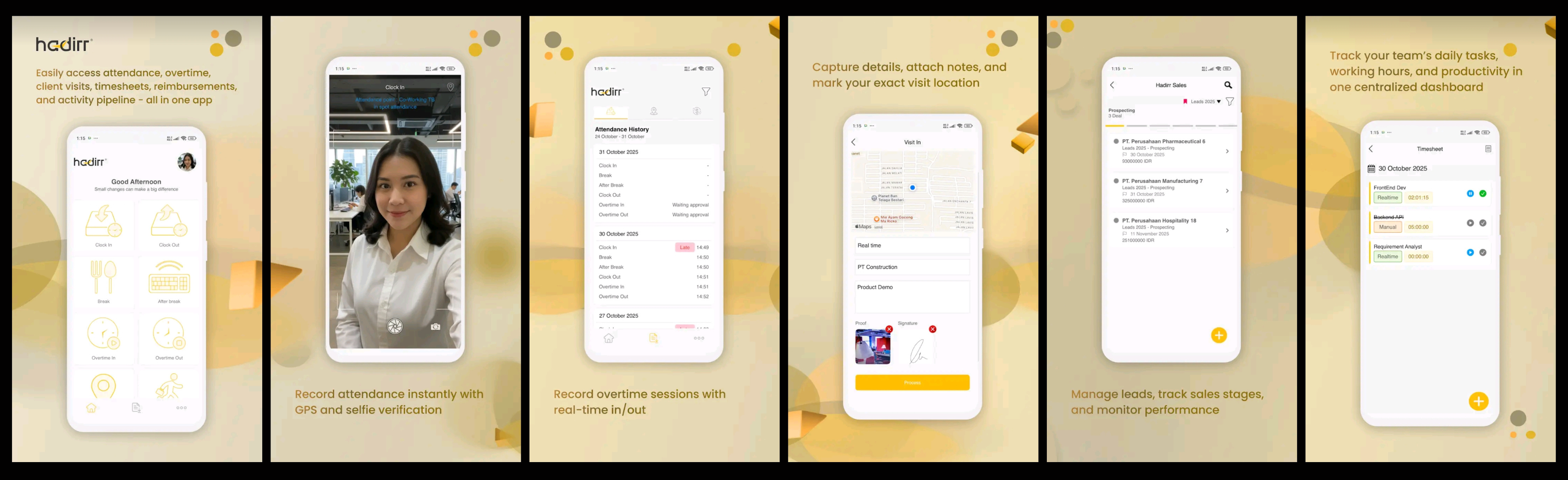
Automated client visit workflow completes in under two minutes. GPS verification happens automatically at check-in, no manual coordinate entry, no separate location confirmation step. Client records surface from the existing account list with one tap. Meeting notes, follow-up actions, and stage progressions log on a single screen. Digital signature capture uses the phone’s native interface. The visit is documented before the rep reaches their car.
Designed for Real Field Conditions
This speed matters for Malaysian field sales reality specifically. A rep covering eight clients across Puchong, Klang, and Shah Alam in a single day has limited time for administrative tasks between visits. Making real-time logging the path of least resistance, not an additional burden on top of the day’s work, is what separates an app reps use from one they tolerate.
Real-Time Pipeline Visibility
Every documented visit feeds directly into pipeline management on the same mobile interface. Pipeline stages, customer records, deal history, and activity logs are already there. It stays current, reflecting the visits logged earlier in the day, without requiring the rep to open a separate CRM between meetings.
Trusted Data for Management Decisions
For sales managers, the outcome of this design is data they can trust. When reps use the app in real time because it helps them, not just because compliance requires it, visit data, pipeline data, and activity records reflect what’s actually happening in the field. Territory gaps are real gaps, not reporting gaps. Pipeline stages reflect genuine commercial positions, not weekend catch-up entries.
When field execution connects directly to commercial outcomes in a single system, the loop closes. The gap between what management thinks and what actually happens in the field disappears.
Built for High-Volume Sales Teams
For Malaysian sales teams where incentive calculations depend on verified activity and manager-rep trust depends on shared data, that closed loop is where the field sales app delivers its most tangible value.
Hadirr supports more than 10,000 companies across Southeast Asia, including field sales teams in FMCG, pharmaceutical distribution, financial services, and B2B technology where daily visit volume and pipeline accuracy are the metrics that determine revenue outcomes.
Also read: Field Sales Software for Malaysian SMEs: Stop Guessing, Start Tracking
The App the Team Chooses to Use
There are two kinds of field sales apps. The kind that gets deployed and then quietly ignored by 66% of the team. And the kind that reps open first thing in the morning because it makes their day better.
The difference isn’t features. Features are table stakes. The difference is whether the app was designed for the person holding the phone or for the person watching the dashboard.
Field sales app adoption is the only metric that determines whether any other metric improves. Territory coverage data is only accurate if reps log visits in real time. Pipeline data is only reliable if reps update stages as conversations progress. Incentive calculations are only fair if visit records are verified rather than reconstructed.
The right app delivers all of this not by making monitoring unavoidable, but by making logging fast and useful enough that reps choose to do it accurately every time, serving their interests as much as it serves management’s.
Let’s make adoption more genuine. Explore Hadirr and see how your field team performs when they actually use the app.