

Timesheet App Malaysia: Track Time, Protect Project Margins
A construction contractor in Petaling Jaya quotes a renovation project at RM80,000. Like many project-based businesses, he is not thinking about whether a timesheet app Malaysia could protect his margins. Labour hours seem straightforward. Six workers, eight weeks, standard rates.
The project finishes ten weeks later. Actual labour cost: RM 102,000.
Nobody stole anything. Nobody padded the books. The hours simply went untracked between tasks, across sites, and in the gap between what got logged and what actually happened. A proper timesheet app Malaysia contractors trust would have caught this in week three, not at final invoicing.
This is the margin problem most Malaysian project-based businesses never see coming. Not fraud. Not laziness. Just hours that exist in reality but never make it into a system anyone can act on.
Why Malaysian Project-Based Businesses Lose Money on Hours They Never Tracked

Cost overruns in Malaysia are not rare. They are the default outcome.
Research on Malaysian construction projects found that 76% of public sector projects and 84.3% of private sector projects experience cost overruns. Most fall in the 10% range or below individually. Across a full project portfolio, that adds up fast.
The pattern extends beyond construction. Creative agencies underbill clients because nobody tracked revision rounds accurately. IT consultancies absorb scope creep because the hours spent on “quick favours” never entered any system. Engineering firms lose margin on projects that looked profitable at the quote stage and broke even by delivery.
The common thread: businesses bill clients and pay staff based on hours. But most Malaysian SMEs track those hours with tools built for attendance, not for project economics. A clock-in and clock-out tells you someone worked eight hours. It tells you nothing about which project consumed that time, whether the task matched the original scope, or whether the client should be billed for it.
Online timesheet Malaysia businesses rely on for project costing needs to answer a different question entirely. Not “did they work today?” but “what did that work actually cost, and does it match what we quoted?”
Also read: Employee Digital Timesheets for Accurate Working Hours Tracking
What Manual Timesheets Miss
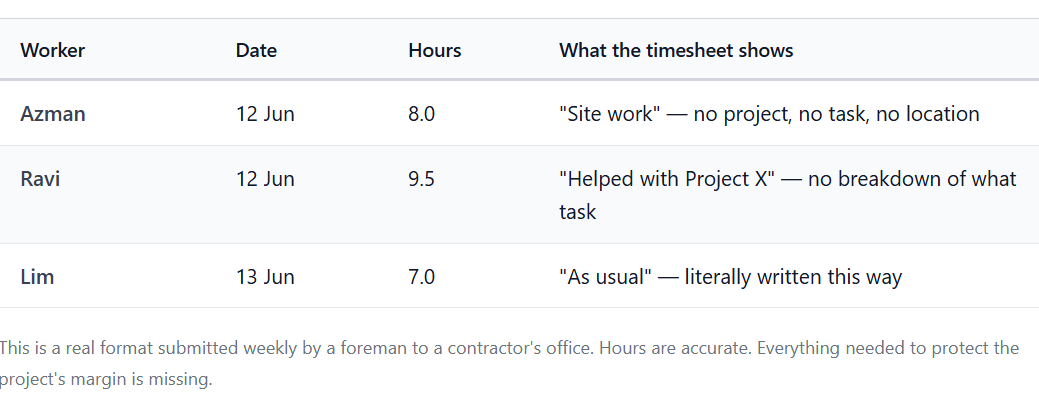
A typical manual timesheet looks complete. It has names, dates, and hours. That is exactly the problem. It looks complete while hiding the information a business actually needs to protect its margin.
Here is a real example of what a foreman submits at the end of a week:
Also read: Multi-Site Attendance Tracking Software for HR Teams in SEA
The Margin Leak That Needs a Timesheet App Malaysia to Close

Three specific leak points drain profitability in Malaysian project-based businesses. Each one is invisible until the project closes and the numbers stop matching.
Under-billing because hours never got logged at task level
A consultant spends three hours on a client call that started as a quick question and became a strategy session. Nobody logged it against the project. The client gets billed for the original scope. The consultancy absorbs three unpaid hours.
Multiply this across a team of ten consultants handling twenty active projects. The unbilled hours compound into a margin problem that nobody notices until annual profitability review reveals certain project types consistently underperform.
Project quotes based on guesswork instead of historical data
A design agency quotes a branding project based on what “feels right” rather than what similar projects actually took last quarter. Without project time tracking Malaysia agencies can pull historical data from, every quote is a fresh guess. Some projects make excellent margins by luck. Others lose money by the same luck running the other way.
Project costs that never get reconciled against the original quote
A project finishes. The team moves to the next one. Nobody goes back to compare actual hours spent against the original estimate. The business has no feedback loop telling it which project types are reliably profitable and which ones quietly bleed margin every time.
This is the most expensive leak because it repeats. A business that loses 15% margin on a specific project type will keep losing it, project after project, until someone builds a system that surfaces the pattern.
Also read: Best Operations Management Software for Branch in Malaysia
How Timesheet App Malaysia Helps Project Costing

Generic time tracking tools record hours. Project costing software Malaysia businesses actually need does something more specific.
Task-level and project-level categorisation
Every logged hour must attach to a specific project and, ideally, a specific task within that project. “Worked eight hours” tells a business nothing actionable. “Spent three hours on client revisions for Project X, two hours on internal planning for Project Y” tells a business exactly where time and cost are going.
Real-time cost versus budget visibility
A project manager who discovers a budget overrun at final invoicing has already lost the opportunity to fix it. Billable hours tracking Malaysia teams use for active project management surfaces the comparison in real time. When a project hits 70% of budgeted hours at 50% completion, someone needs to know immediately, not at month end.
Direct connection to client billing
The gap between hours worked and hours billed is where most under-billing happens. A digital timesheet software Malaysia business uses for client-facing work should connect logged hours directly to invoice generation, removing the manual translation step where billable time quietly disappears.
Mobile logging for field-based and distributed teams
Construction supervisors, field engineers, and on-site consultants do not sit at desks. A mobile timesheet app Malaysia for field teams needs to work from a phone at a job site, with offline capability for locations where connectivity drops.
Historical data that improves future quoting
Every completed project becomes a data point for the next quote. Timesheet management software Malaysia businesses should retain that data accessibly, so the next similar project gets quoted based on evidence rather than optimism.
Also read: Best CRM Software in Malaysia for SMEs (2026 Guide)
How Different Malaysian Industries Use Timesheet Data to Protect Profitability
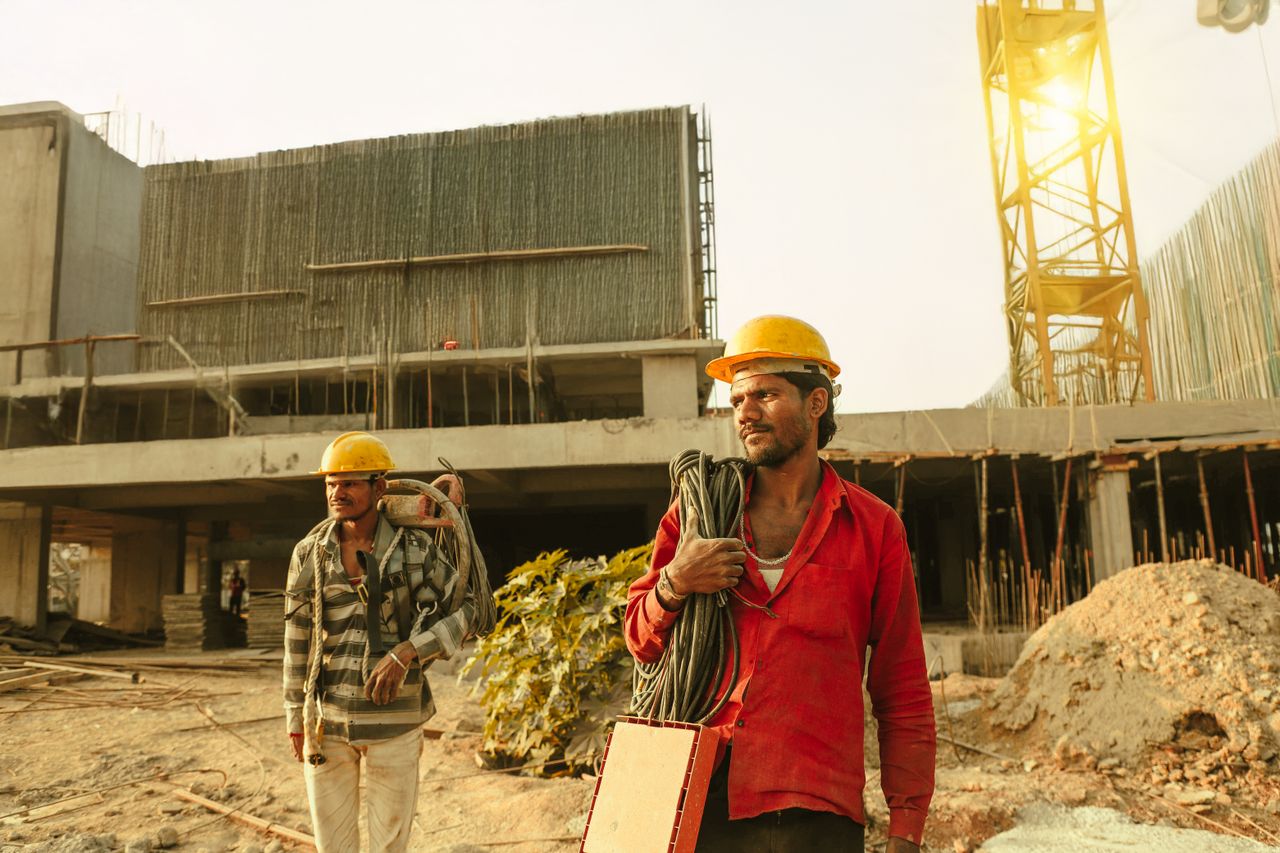
The margin leak looks different across Malaysian project-based sectors, but the underlying fix is the same.
Construction and renovation contractors
A contractor in Shah Alam manages crews across multiple sites simultaneously. Construction timesheet app Malaysia contractors use must track hours by site and by trade, since labour cost varies significantly between general workers and specialised tradespeople. Without site-level breakdown, a contractor cannot tell which project is consuming labour faster than budgeted until the whole portfolio’s margins compress.
Creative agencies and marketing consultancies
An agency in Kuala Lumpur runs ten client accounts simultaneously, each with different scopes and different revision allowances. Task-level time tracking reveals which clients consistently exceed their contracted revision rounds, information the agency needs before renewal negotiations, not after a year of unprofitable service.
Engineering and technical consultancies
A consulting firm in Penang bills clients by project phase. Time tracking for SMEs Malaysia in this sector needs to separate billable client hours from internal training, proposal writing, and business development time, since blending these categories makes it impossible to calculate true project profitability.
IT services and software development
A development house quotes fixed-price projects based on estimated hours. When actual hours exceed estimates due to scope creep, accurate timesheet data becomes the evidence needed for change order conversations with clients, rather than the firm silently absorbing the overrun.
Also read: Best Shift Scheduling Software for SEA Operations Teams
How Hadirr’s Timesheet App Works for Malaysian Project-Based Teams

A renovation contractor in Shah Alam runs four active projects with six different crews. Before, tracking which crew spent how long on which site meant calling each foreman every evening for a verbal update.
Now, every crew member clocks in through Hadirr’s mobile app at the actual job site. GPS confirms the location. The system attributes the time directly to that project automatically, removing the manual step where hours get misallocated or simply forgotten.
As the week progresses, the project manager checks the dashboard and sees hours accumulating against each site in real time. When one project starts consuming labour hours faster than its original budget allows, the manager sees it on day twelve, not at final reconciliation. There is still time to adjust crew allocation or flag a scope change with the client before the margin disappears entirely.
At month end, the digital timesheet generates automatically from verified attendance data, broken down by project and by site. The contractor’s accountant pulls actual labour cost per project without reconstructing anything from foreman notebooks or memory. The comparison against original quotes happens in minutes, not days.
This same structure works for the consultancy in Penang tracking billable hours by client, and for the agency in Kuala Lumpur monitoring revision time by account. The underlying mechanism stays consistent. Every hour gets attributed correctly, in real time, without anyone needing to reconstruct it later.
Over time, this builds something most Malaysian project-based businesses never have: a reliable historical record of what similar projects actually cost. The next quote stops being a guess. It becomes a calculation based on evidence the business already owns.
Also read: 5 Best Shift Management Software for SMEs in Malaysia 2026
The Margin You Cannot See Is the Margin You Lose
Cost overruns rarely announce themselves. They accumulate quietly, hour by hour, project by project, until annual reviews reveal that certain work types never actually make the money everyone assumed they did.
A reliable timesheet app Malaysia project-based businesses can trust does not just satisfy payroll requirements. It closes the gap between what a business thinks it earns and what it actually earns on every project it delivers.
The contractor who tracks hours by site catches budget overruns in week three instead of week ten. The consultancy that tracks billable time by client knows exactly which accounts deserve renewal at higher rates. The agency that retains historical project data quotes the next job based on facts, not optimism.
Explore Hadirr’s timesheet app and start protecting margins you cannot currently see.