

5 Best Shift Management Software for SMEs in Malaysia 2026
The owner of a nasi lemak restaurant in Subang Jaya runs her shifts the same way most Malaysian SME owners do: WhatsApp group, shared notes, and a mental map of who works when. It works until it doesn’t, and the lack of proper shift management software starts to show.
One Tuesday morning, two staff members show up for the same breakfast shift while the lunch shift has no coverage at all. Managing twelve staff across three daily shifts via WhatsApp had felt manageable. It wasn’t a system. Just improvisation that happened to work most of the time.
Most Malaysian SME owners know this feeling. They’re not running HR departments. They are the HR department while also serving customers, managing suppliers, and keeping the books. Shift scheduling happens in the gaps between everything else, which means it rarely gets the structure it needs until something goes wrong.
Why Shift Management Is the Hardest Part of Running a Malaysian SME

Enterprise businesses have dedicated HR teams, scheduling software, and operations managers whose entire job is workforce coordination. Malaysian SMEs have the owner, a senior staff member, and a WhatsApp group.
This creates shift management challenges that enterprise tools aren’t designed to solve, and that generic scheduling apps underestimate.
Last-minute swap requests are constant
Malaysian SME staff, particularly in F&B, retail, and personal services, frequently request shift swaps, from family obligations to public holiday plans and overlapping festive periods like Raya, Chinese New Year, and Deepavali. Each swap request arrives via WhatsApp.
The owner has to manually check who is available, confirm coverage, and update whatever record exists. Multiply this by twelve staff and thirty working days and it consumes hours every month.
Public holiday scheduling is a recurring nightmare
Malaysia has one of the highest numbers of public holidays in the world, including federal holidays, state holidays, and religious observances that vary by state and by employee religion. A F&B outlet in Johor Bahru needs a different holiday schedule than one in Kuala Lumpur.
A team with mixed Muslim, Chinese, and Indian staff has different leave and scheduling expectations across the calendar. Without shift management software that handles this complexity automatically, owners compile separate schedules manually for every major holiday period.
Payroll depends on shift records nobody properly maintains
Staff pay in shift-based Malaysian SMEs often varies by shift type, with different rates for morning, afternoon, and night shifts, weekend premiums, and public holiday multipliers. When shift records live in WhatsApp and memory, payroll at month end becomes an estimation exercise.
The owner reconstructs who worked which shifts from chat messages, handwritten notes, and staff recollections. Errors accumulate. Disputes follow.
Coverage visibility doesn’t exist until it’s too late
The owner of a retail outlet in Mid Valley doesn’t know she’s understaffed for Saturday afternoon until Saturday afternoon. Without a system that shows shift coverage across the whole schedule in advance, gaps surface as crises rather than as planning opportunities.
Also read: Field Sales Software for Malaysian SMEs: Stop Guessing, Start Tracking
What Shift Management Software for SMEs in Malaysia Should Include

SME owners don’t have time to learn complex software. They need shift management software that works like WhatsApp, intuitive and mobile-first, but produces the structured records that payroll and compliance require.
Shift tools that fit SMEs should include these capabilities:
Mobile-first design that works on any Android phone
The owner manages the business from a phone, not a desktop. Staff receive notifications and confirm shifts from phones. Any shift management software for Malaysian SMEs that requires desktop access for core functions will be abandoned within two weeks. Mobile-first isn’t a feature preference. It’s a survival requirement for SME adoption.
Drag-and-drop shift creation without a training manual
The right software creates a shift roster in minutes, not hours. Drag-and-drop assignment, template-based scheduling for recurring patterns, and automatic staff notification when shifts are created or changed. If it takes more than 30 minutes to learn the basics, an SME owner won’t invest the time.
Shift swap management with approval controls
Staff swap requests shouldn’t arrive as WhatsApp messages that the owner has to manually reconcile. The right system routes swap requests through a structured workflow: the employee submits a request, the owner or manager approves or rejects it, and the roster updates automatically. Every swap generates a documented record. No more reconstructing from chat history.
Integration with attendance and overtime tracking
A shift roster that doesn’t connect to actual clock-in data is a plan, not a record. Shift management software Malaysia SMEs can rely on must connect shift assignments to verified attendance, confirming that the person who was scheduled actually showed up, on time, and worked the expected hours. When shifts connect to overtime tracking, the owner can see in real time whether any staff member is approaching monthly hour limits before scheduling additional shifts.
Affordable pricing for small teams
Malaysian SMEs operate on tight margins. Shift scheduling software priced per-user at enterprise rates becomes expensive fast for a fifteen-person team. The right tools for SMEs offer free tiers for small teams, affordable entry pricing, or flat-rate plans that don’t punish growth.
Also read: Best CRM Software in Malaysia for SMEs (2026 Guide)
5 Best Shift Management Software for SMEs in Malaysia

These five tools handle shift scheduling for small teams with different strengths. Each fits a different SME context, and all of them are absent from our earlier comparisons focused on enterprise operations teams and regional multi-country businesses.
Hadirr
Built for Southeast Asian SMEs that need shift scheduling connected to verified attendance and overtime management, without enterprise pricing or implementation complexity. Where the four tools above handle scheduling well in their specific contexts, Hadirr connects shift management to the full workforce record: who was scheduled, who actually showed up, how long they worked, and whether any overtime was properly approved. More on this below.
7shifts
Purpose-built for F&B businesses, including restaurants, cafes, and food service operations of any size. 7shifts handles shift scheduling, staff communication, and labour cost tracking in one mobile app. Its free tier covers up to thirty employees, which makes it accessible for most Malaysian F&B SMEs.
The scheduling interface is genuinely intuitive. Managers create rosters, staff confirm availability, and the system flags scheduling conflicts before the roster is published. The limitation for Malaysian SMEs: 7shifts is designed for the North American F&B market and doesn’t natively handle Malaysian Employment Act overtime calculations or state-specific public holiday rules.
Sling
A free-tier scheduling tool with strong communication features. Sling handles shift scheduling, team messaging, and task management together, useful for SMEs where the same tool needs to coordinate both scheduling and day-to-day operations communication.
Its free plan covers unlimited users with basic scheduling, making it one of the most accessible entry points for Malaysian SMEs testing structured shift management for the first time. Advanced features like labour cost tracking and overtime alerts require paid tiers.
Factorial HR
An HR suite that includes shift scheduling as part of broader people management: leave, payroll preparation, performance, and scheduling in one platform. Factorial works well for SMEs that want to consolidate HR functions rather than running separate tools for each.
Its shift scheduling interface is clean and mobile-accessible. The tradeoff is pricing. Factorial’s per-employee monthly cost adds up for small Malaysian SMEs that only need scheduling without the full HR suite.
Snap Schedule
Designed for small teams with complex rotating schedules. Snap Schedule handles shift patterns, availability tracking, and coverage visualisation with more depth than most consumer-grade scheduling apps.
It’s a strong fit for Malaysian SMEs in healthcare, security, or facility management where rotating schedules require careful pattern management. Less suited for simpler F&B or retail scheduling needs where the priority is ease of use over scheduling complexity.
Also read: Best Shift Scheduling Software for SEA Operations Teams
How Hadirr’s Shift Management Software Works for Malaysian SMEs

Rather than listing features, here are the three moments in every Malaysian SME’s working week where the right shift management software makes the biggest difference, and what changes when Hadirr handles them.
Moment One: Building the Weekly Roster
It’s Sunday evening. The owner of a beauty salon in Bangsar needs to finalise the week’s roster for eight therapists across morning and afternoon shifts. Without a system, this takes 45 minutes of cross-referencing availability messages, manually balancing coverage, and typing out the schedule into a WhatsApp group.
With automated shift scheduling, the roster builds in minutes. Shift patterns template automatically from the previous week. The owner adjusts for leave requests already submitted through the app. Each therapist receives an automatic notification when the roster is published.
The roster that used to take 45 minutes takes 5. The coverage gaps that used to surface on Monday morning surface on Sunday evening when there’s still time to fix them.
Moment Two: The Last-Minute Swap Request
It’s Wednesday at 2 pm. A staff member at a retail outlet in Pavilion messages the owner: can’t make Thursday morning shift, family emergency. Without a system, the owner spends the next 30 minutes calling available staff, confirming the swap, and manually updating whatever record exists.
With Hadirr, the staff member submits a swap request through the app. The owner sees the request, checks available replacements, filtered automatically by shift eligibility and current hour accumulation, and approves. The replacement receives a notification. The roster updates. The attendance system will verify the replacement’s GPS clock-in on Thursday morning, confirming the shift was actually covered by the right person.
The 30-minute phone-call process becomes a 3-minute app interaction. The swap is documented. The coverage is confirmed.
Moment Three: Month-End Payroll
It’s the last Friday of the month. The owner needs to calculate pay for 12 staff across varying shift types: morning rates, afternoon rates, weekend premiums, and three instances of approved overtime during the month.
Hadirr routes every overtime request through a digital approval workflow during the month. Every approved session is timestamped and documented. The timesheet generates automatically from verified attendance and approved overtime, no manual compilation, no reconstructing from chat messages.
What used to take a full day now takes a fraction of the time. The output is clean, verified, and defensible, whether it’s reviewed by an accountant or an auditor.
Together, these three moments show what shift management software built for Malaysian SME reality actually changes: not the complexity of the scheduling problem, but the timing of when the right person has the right information to make the right decision.
Thousands of SMEs across Southeast Asia, including Indonesia, Malaysia, and Singapore, use Hadirr to manage schedules and shifts for small to medium teams, reducing the manual work behind day-to-day operations.
Also read: How to Track Field Sales in Malaysia Without Violating PDPA
Shifts That Run Themselves
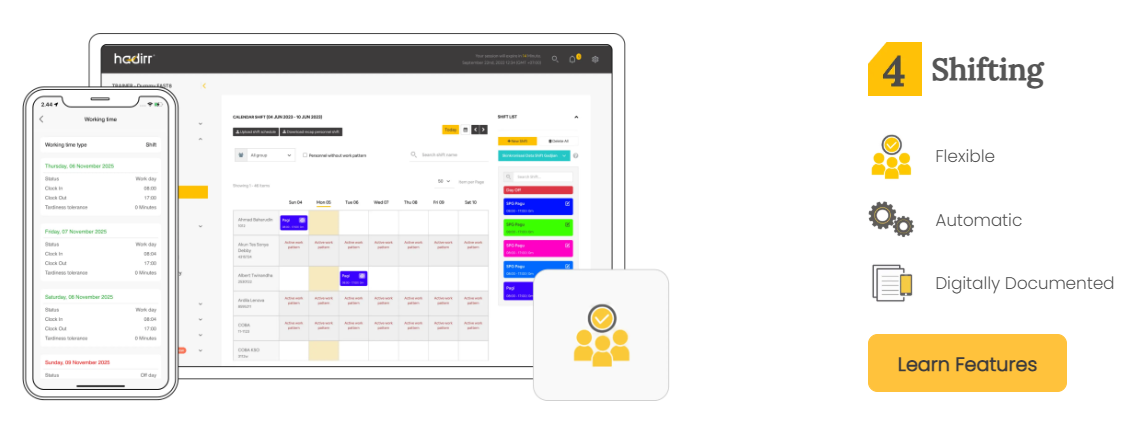
The right shift management software doesn’t eliminate the unpredictability of running a Malaysian SME. Staff will still call in sick on busy days. Public holidays will still create scheduling complexity. Last-minute changes will always happen.
What changes is what happens next. A structured system turns an hour scramble into a few minute workflow. A documented swap request replaces a reconstructed chat history. A verified attendance record replaces a best-guess payroll calculation.
For Malaysian SME owners who are already doing everything, from serving customers to managing operations, and somehow also managing shifts, the right shift management software doesn’t add work. It removes the parts of shift management that shouldn’t require human effort at all.
Ready to move beyond managing shifts through WhatsApp? Explore Hadirr and see what shift management looks like when it actually fits how a Malaysian SME works.