

Top Overtime Tracking Tools for Multi-Location Teams in Malaysia
Every month, the same conversation happens in the boardroom of a retail chain headquartered in Petaling Jaya, the kind of situation that exposes why the right overtime tracking tools matter. The CFO pulls up the payroll report. Overtime cost is, again, higher than budgeted.
The operations director calls all branch managers. Every branch manager says the same thing: everything was under control at their location. Nobody is lying. Nobody is padding numbers. The overtime just accumulated across seven locations, in small increments and invisibly, until payroll made it visible.
This is the core problem that the right overtime tracking tools solve. Not fraud. Not non-compliance. The quiet, compounding accumulation of extra hours across multiple locations that no single manager sees in full until the cost is already locked in.
How Overtime Accumulates Invisibly Across Multiple Locations

Multi-location businesses don’t usually experience one dramatic overtime event. They experience dozens of small ones simultaneously, each manageable at location level but collectively expensive at company level.
Three mechanisms drive this pattern in Malaysian multi-location operations.
The substitution cascade
A branch employee calls in sick. The branch manager finds a replacement from the available pool, ideally someone not already near their weekly hour limit. But in practice, the replacement is usually whoever answers the phone fastest. The replacement covers the shift. Their hours for the week tick upward.
Nobody flags it because at branch level, the shift was covered and operations continued normally. At company level, across seven branches each making similar decisions two or three times a month, the substitution cascade adds hundreds of unplanned overtime hours to the monthly payroll.
Overtime tracking tools that operate only at branch level don’t catch this pattern. Only tools with cross-location visibility can flag the cascade before it compounds by showing accumulated hours per employee across all assignments, regardless of which branch they worked on.
The approval gap between locations
In multi-location operations, overtime approval authority often sits at branch manager level. Branch managers approve overtime for their own staff through whatever channel is most convenient, typically WhatsApp. HQ sees the cost in payroll but has no visibility into the approval trail: who authorised what, when, against which attendance record, and whether the approval was given before or after the hours were worked.
This approval gap creates two problems simultaneously. Overtime that should have been prevented gets approved because no one at branch level is checking company-wide accumulation. And overtime that was legitimately approved has no auditable documentation, which creates Employment Act exposure when disputes surface.
The gradual drift past legal limits
Malaysia’s Employment Act caps overtime at 104 hours per month. At a single location, this limit is easy to monitor. Across seven locations with employees who sometimes work substitution shifts at different branches, tracking total monthly hours per employee becomes genuinely complex.
An employee who works 40 hours of overtime at their primary branch and another 32 at a secondary branch during a substitution has accumulated 72 hours, still within limits. Add a busy final week and the limit approaches without anyone at either branch having the full picture.
The right overtime management software Malaysia multi-location businesses need tracks accumulated hours per employee across all locations simultaneously, not per location independently.
Also read: 7 Best Tools to Track Overtime Hours in Southeast Asia
What Overtime Tracking Tools for Multi-Location Teams Must Handle

Multi-location overtime tracking has different requirements from single-site tracking. Four capabilities define tools that genuinely work at scale versus tools that work in demos but create gaps in operations.
Cross-location hour accumulation per employee is the most fundamental requirement
An employee’s overtime accumulation must be visible in aggregate across every location they work, every shift they cover, and every substitution they complete. Tools that track hours per location rather than per employee across locations will always undercount total exposure.
Pre-approval workflows with visibility into current accumulation
Approval that happens after overtime is worked is approval that doesn’t prevent cost. It only documents it. The right overtime approval system Malaysia operations need routes every request through a digital workflow where the approver sees the employee’s current month-to-date accumulation before confirming. An employee at 89 hours of overtime in week three triggers a different decision than one at 42 hours.
Real-time cross-location dashboard for operations management
HQ needs to see overtime accumulation across all locations simultaneously in real time, not in weekly reports that arrive after the decisions have already been made. Real-time overtime visibility at company level is what converts overtime tracking from a payroll function into an operational management tool.
Verified attendance as the overtime foundation
Overtime hours calculated from self-reported clock-ins are only as reliable as employee honesty and memory. Multi-location overtime tracking tools that build on GPS-verified attendance with facial recognition produce overtime records anchored in verifiable data, which matters both for operational accuracy and for Employment Act compliance documentation.
Also read: Multi-Site Attendance Tracking Software for HR Teams in SEA
Top Overtime Tracking Tools for Multi-Location Teams in Malaysia

These tools handle overtime tracking for distributed teams with varying strengths. Each fits a different operational context, and none of them appeared in our earlier comparison focused on single-location overtime compliance tools.
Hadirr
Built specifically for Southeast Asian multi-location operations, Hadirr is designed around a problem most global tools only partially address: overtime that accumulates across locations without visibility until payroll closes. Hadirr combines GPS-verified attendance, facial recognition, cross-location overtime tracking, and structured approval workflows in one system. Every clock-in is tied to a verified location and identity, so overtime is calculated from data that can be traced and audited, not self-reported entries.
Overtime requests go through a digital approval workflow where managers see verified attendance records and current month-to-date hours before approving. Each decision is documented with a clear audit trail aligned with Malaysia’s Employment Act requirements. This makes it particularly effective for multi-location teams that need to control overtime before it compounds, not just report it after the fact.
Hubstaff
A strong fit for remote and hybrid teams where overtime tracking connects to productivity monitoring and project billing. Hubstaff tracks hours by project and task, generates overtime reports, and sends automated alerts when employees approach weekly limits. Its GPS tracking capability makes it usable for field teams.
The limitation for Malaysian multi-location operations is structural: overtime is tracked per project rather than against legal monthly caps. This means Employment Act compliance still requires manual calculation on top of the system’s output, especially when employees work across multiple assignments.
Deputy
Built for shift-based workforces in hospitality, retail, and healthcare. Deputy handles roster management and overtime visibility together, allowing managers to see who is approaching overtime limits before assigning additional shifts.
Its award interpretation engine is built around Australian compliance frameworks, which means overtime calculations under the Malaysian Employment Act require manual configuration. A credible option for Malaysian operations that primarily need shift-based overtime prevention rather than compliance documentation.
Time Doctor
Designed for remote teams and distributed workforces where productivity monitoring and overtime tracking run together. Time Doctor tracks active work time, generates detailed overtime reports, and integrates with payroll systems.
Its strength is visibility into how time is spent, useful for knowledge worker teams billing by the hour. It is less suited for operational teams where the overtime question is about shift hours and compliance thresholds rather than task-level time allocation.
Clockify
A free-tier time tracking tool with overtime reporting capability. Clockify works well for small multi-location teams that need basic overtime visibility without a significant software budget. It generates overtime reports by employee and by project.
The limitations become apparent at scale: no built-in approval workflows, no automated threshold alerts, and no GPS verification, which means it handles overtime reporting but not overtime prevention or compliance documentation for Malaysian Employment Act purposes.
Jibble
A Southeast Asia-friendly attendance and overtime tracking app with GPS clock-ins and facial recognition. Jibble handles multi-location attendance with geofencing, tracks overtime hours against configurable limits, and generates payroll-ready reports.
Its compliance framework is more adaptable to Malaysian requirements than most Western-built tools. The overtime approval workflow is less structured than purpose-built systems, useful for teams that need overtime visibility, but less comprehensive for those that require a full approval trail.
Also read: How to Track Field Sales in Malaysia Without Violating PDPA
How Hadirr’s Overtime Tracking Tools Work Across Multiple Locations

From Partial Tools to a Connected System
Most overtime tracking tools in this comparison do one thing well. Hubstaff tracks time by project. Deputy manages shift rosters. Clockify generates reports. Jibble handles GPS clock-ins. Each solves part of the problem.
Hadirr solves the part that matters most for Malaysian multi-location businesses: connecting verified attendance to overtime management in one system, across every location simultaneously.
Why Verified Attendance Changes Everything
Here’s why that connection matters. Overtime records are only as reliable as the attendance data underneath them. A tool that tracks overtime hours but accepts self-reported clock-ins is tracking what employees say happened, not what actually happened.
When an overtime dispute surfaces or an Employment Act audit arrives, self-reported records don’t carry the same weight as GPS-verified, facial recognition-confirmed attendance tied to every overtime calculation.
Real-Time Visibility Across Every Location
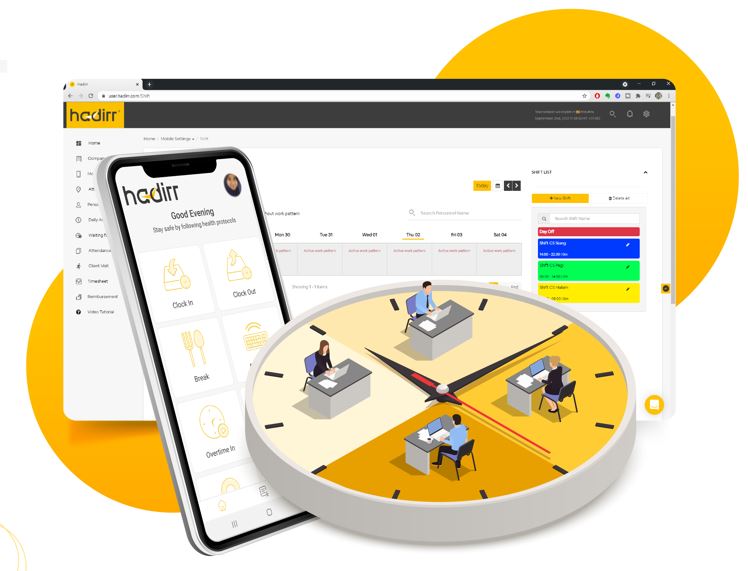
Hadirr’s attendance feature establishes that verified foundation. Every clock-in carries a GPS location and a facial recognition confirmation. Managers see real-time attendance across all locations on one dashboard—whether the team is spread across Shah Alam, Johor Bahru, or Penang.
Late arrivals surface the same day. Location anomalies flag immediately. The attendance record that feeds overtime calculations is verified before any overtime request is even submitted.
Structured Approval Before Overtime Happens
The overtime management routes every request through a digital approval workflow. The manager reviews the employee’s real-time accumulated overtime hours for the month before approving.
Approved overtime carries a timestamp, an approver identity, and a link to the verified attendance record underneath it—the documentation chain that satisfies Malaysia’s Employment Act requirements without any additional preparation.
Visibility While There’s Still Time to Act
For multi-location businesses, this real-time accumulation view is where Hadirr separates itself from tools that only report overtime after the fact. The operations manager reviewing accumulated hours mid-month across all branches simultaneously can make scheduling adjustments before costs compound.
It’s a live dashboard that shows exactly where each employee stands, any time the manager chooses to look.
From Verified Data to Payroll-Ready Output
When overtime is approved and the month closes, the overtime recap generates automatically from verified attendance and approved overtime records across every location. No manual compilation. No reconciling eight different branch spreadsheets. One clean, verified output that payroll can process and auditors can trust.
What Actually Changes for the Business
For Malaysian multi-location businesses where overtime cost consistently exceeds budget and nobody can explain why until month end, this is what changes: when visibility arrives. Not after payroll. During the month, when there’s still time to act on it.
Hadirr supports thousands of businesses across Southeast Asia, managing distributed workforces where overtime accumulation across locations is a real and recurring operational challenge.
Also read: Stop Client-Site Fraud with Geofencing Client Solutions in Malaysia
Overtime Managed Before It Costs
Multi-location overtime doesn’t announce itself. It accumulates quietly, one substitution, one approved chat message, one unchecked week at a time, until the payroll report makes the total visible and the budget conversation becomes uncomfortable.
The right overtime tracking tools for multi-location teams don’t eliminate overtime. They move the moment of visibility from month-end to real-time, giving operations managers the information to make different decisions before the cost compounds.
For Malaysian businesses where that monthly payroll conversation keeps delivering the same surprise, the system isn’t working. The data exists. It’s just arriving too late to act on.
Stop discovering overtime after the fact. Get started with Hadirr and give your operations team visibility across every location before the month closes.