

Attendance Software for Small Business: Avoid Costly HR Risks
An Australian founder runs a small office in South Jakarta. Eight employees. Lean team. No HR department. For 18 months, everything runs smoothly. Attendance is tracked in a WhatsApp group. Overtime is approved in chat. No need for attendance software for small business—it sounded like something built for companies with hundreds of staff, not a tiny representative office.
That assumption breaks the moment his senior sales rep resigns.
Three weeks later, a lawyer’s letter arrives: a claim for 14 months of unpaid overtime, roughly Rp 45 million. The only “records” the company has are scattered chat approvals, half-complete screenshots, and three different versions of a spreadsheet with unclear timestamps.
The system worked fine until it needed to work. Then it didn’t.
When an auditor or legal reviewer asks for original attendance and overtime records, there is nothing that meets the legal standard. Suddenly, not investing in systems doesn’t feel like saving money anymore—it feels like a liability
Stories like this are not rare. According to the Chamber of Commerce and Industry (Kadin), Indonesia has more than 60 million micro and small enterprises, employing around 97% of the national workforce and contributing roughly 61% of GDP. Yet many of these teams still run on informal processes that were never designed to survive a dispute, an audit, or even a period of rapid growth.
The right attendance software for small business is less about fancy dashboards and more about basic legal protection: clear, reliable records of who worked, when, and for how long.
Why Attendance Software for Small Business Is Needed Earlier Than Most Think

One of the biggest misconceptions foreign founders bring into Indonesia is the assumption that there must be some “small business exemption” in labor law. In reality, Law No. 13/2003 makes no such distinction.
The same framework that applies to a 600-person factory applies to a six-person sales team. Working hours, overtime limits, and overtime pay are all regulated, and employers are expected to keep proper records—regardless of company size.
That’s why attendance software for small business is not something you add once you reach fifty employees. It’s a basic compliance layer from the moment you hire your first employees. Indonesian regulations cap overtime at four hours per day and 18 hours per week, with specific pay multipliers beyond normal working hours.
In any dispute over unpaid overtime, labor inspectors and courts will look for objective records—attendance logs, overtime requests, and timesheets—not WhatsApp chats or verbal approvals.
From a macro perspective, small and micro businesses form the backbone of the domestic labor market, yet many still operate informally and struggle with documentation and digitalisation. That informality may feel efficient in the early days, but it becomes a real risk the moment questions arise around pay, working hours, or termination. Proper employee time tracking is one of the simplest ways to reduce that risk.
For foreign owners, this becomes even more critical. You’re operating in a jurisdiction where you don’t fully control the language, norms, or enforcement dynamics. A digital attendance system that standardizes how working hours are recorded is one of the few ways to bring consistency—and defensibility—into an otherwise unpredictable environment.
Also read: Top Sales Management Software for Indonesian Businesses
The Real Cost of Running Attendance on WhatsApp and Excel

On paper, WhatsApp and Excel look efficient. Everyone already uses chat. Spreadsheets are free. The team is small, and you trust each other.
The problem isn’t the tools themselves. It’s what happens under stress—when people leave, relationships shift, or the business grows faster than manual processes can keep up.
When attendance and overtime live in a messaging app, there is no consistent attendance tracking for small teams. Messages get buried. Approvals happen verbally and are “confirmed” later. Timesheets vary by manager. When someone questions a payslip, you end up scrolling for context that may not exist. In a formal dispute, this fragmented trail is weak compared to structured logs from an employee attendance app.
Spreadsheets create a different risk. Version control alone can undermine confidence: one file on HR’s desktop, one in a shared drive, another edited locally and never uploaded. Formula errors happen. Data gets overwritten. Hours get adjusted “just this once” without a trace. For something as sensitive as overtime management small business, that’s a serious exposure.
There’s also an inclusion issue. Not every frontline employee logs time consistently. Some fix entries later. Others don’t submit timesheets unless pushed. In small teams, these gaps are often ignored—until someone leaves and reconstructs their hours as part of a claim.
Running attendance on WhatsApp and Excel isn’t free. You’re just paying in time, uncertainty, and legal risk—instead of a predictable investment in attendance software for small business.
Also read: Why Foreign Companies in Indonesia Struggle to Hire Top Locals
What Attendance Software for Small Business Should Actually Include

When evaluating tools, it’s easy to get lost in feature comparisons. A more practical approach is to treat attendance software for small business as a tool for risk management and operational simplicity. At minimum, it should help you answer five questions.
1. Will your team actually use it every day? For a small team, adoption matters more than advanced workflows. The best small business HR software is the one employees open without resistance. Simple check-in flows, clear language, and no training overhead are critical. If it feels like a burden, people will work around it.
2. Does it support a mobile-first, unreliable-internet reality? Teams often move between locations with inconsistent connectivity. A mobile attendance app small business should work on standard Android devices, function offline, and sync reliably. This is essential for field teams.
3. Can it handle overtime and timesheets? You need clear workflows and automatic tracking of actual hours. A good timesheet software should make overtime visible and compliant with local rules. This is where overtime management small business shifts from rough estimates to verifiable data.
4. Does it give you enough data for compliance without turning you into a full-time HR admin? Strong workforce management small business tools provide clear records—who worked, when, and where—without manual reconciliation. That’s the foundation of HR compliance.
5. Can it grow with you? A good digital attendance system should scale as your team expands, while keeping attendance tracking for small teams simple from day one.
If a vendor can’t answer these clearly, features don’t matter. The best attendance software for small business is reliable, compliant, and easy enough that everyone actually uses it.
Also read: A Foreign Business Guide to Indonesia’s Product Certification
How Hadirr Fits Small Business Attendance Needs
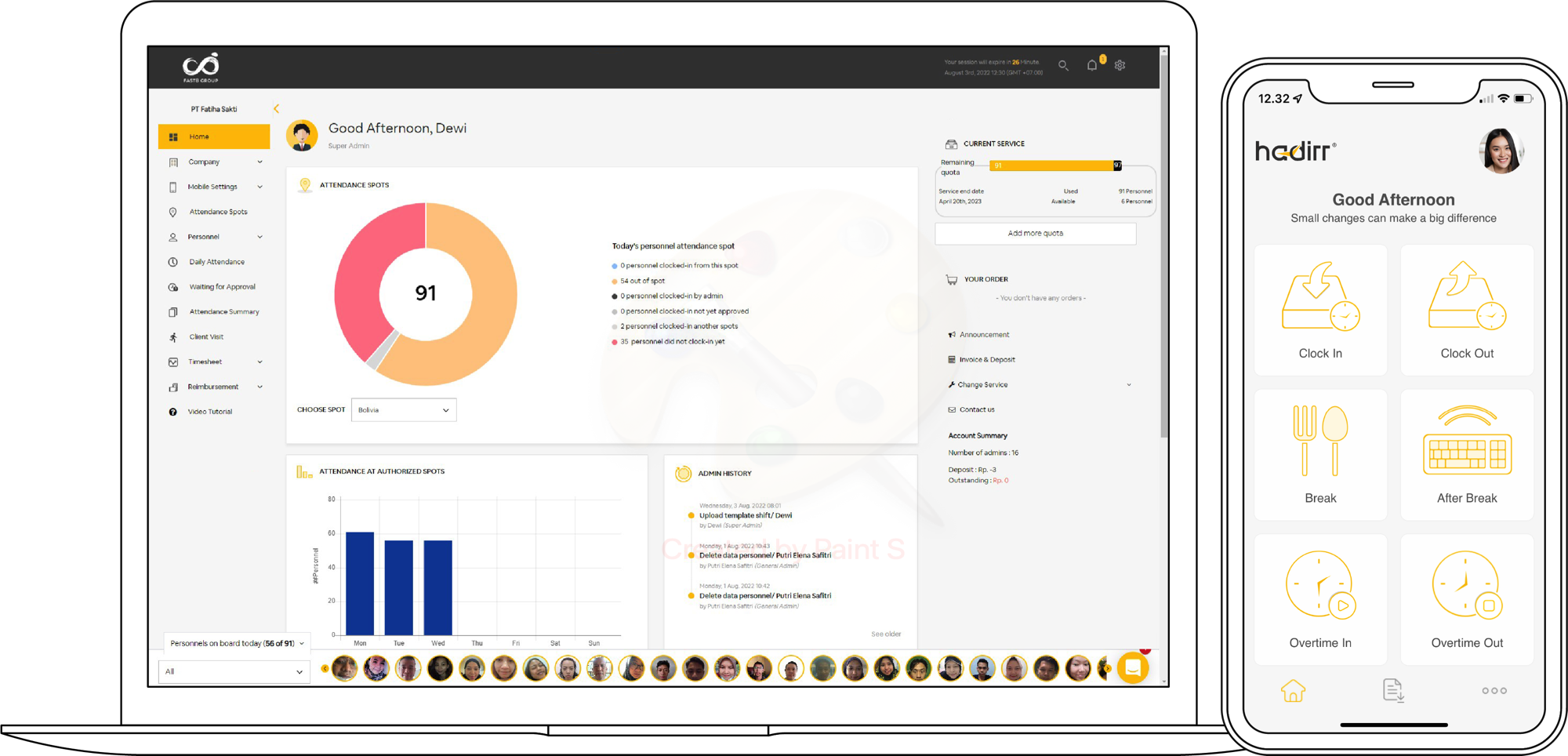
Hadirr is built for the operational reality that small foreign businesses in Indonesia actually face—mobile teams, mixed device ownership, legal compliance requirements, and minimal HR overhead. Its pricing and architecture scale down to small teams without stripping out the features that matter most: reliable, defensible records.
Attendance and Time Tracking
Hadirr captures GPS-verified clock-ins with facial recognition. Every record includes a timestamp, location, and confirmed identity. Managers see real-time attendance across the team, with late arrivals visible immediately—not at month end.
For foreign business owners managing teams remotely or from a shared office, this replaces informal WhatsApp check-ins with records that can hold up in an audit or dispute. The audit trail builds itself.
Lend App—for employees without smartphones
Hadirr’s Lend App solves a problem most global tools ignore. Employees without a personal device—or those who forget it—can borrow a colleague’s phone to clock in. Facial recognition ties the record to the individual, not the device.
For teams with operational or support staff, this removes one of the most common failure points in attendance tracking. No device no longer means a gap in the record.
Overtime Management
Hadirr routes overtime requests through a structured approval workflow. Requests are submitted, approved, and automatically recorded before the hours are worked.
For businesses where overtime disputes are the most frequent source of claims, this creates a complete documentation chain. Every approved session has a timestamp, an approver, and a record—replacing the missing WhatsApp message that often becomes a problem later.
Online Timesheet
Hadirr generates timesheets online directly from attendance and overtime data. At month end, admins download a complete, accurate report—without asking employees to reconstruct their hours.
For teams previously relying on spreadsheets and chat logs, this removes the error layer entirely. Payroll becomes defensible. Client billing becomes reliable. Monthly reconciliation drops from hours to minutes.
Together, these four features give small businesses something WhatsApp and Excel never could: a complete, verifiable workforce record that protects the business before a problem surfaces—not after.
Hadirr has been deployed across thousands of companies. It handles local compliance requirements by design—not as an afterthought.
Also read: Tapping into Indonesia’s Special Economic Zones Advantage
Don’t Wait for Your First Dispute

If your team is still small, it’s easy to postpone all of this. Maybe you’ve been lucky so far. Maybe everyone is trustworthy and aligned. But Indonesia’s labor regulations, the scale of its SME workforce, and the reality of disputes mean one thing: luck is not a strategy.
You don’t need a full HR department. What you need is a minimal, reliable layer of documentation—who worked, when, and where; which overtime was requested and approved; and how that translated into pay. The right combination of HR software and operational discipline can give you that without slowing the business down.
If you’re running a small team in Jakarta, Bandung, or Bali and still relying on WhatsApp and Excel, consider this your warning shot. Start simple. Start small. But start now.
The best attendance software for small business is the one you implement before that first lawyer’s letter arrives.
Try Hadirr free and bring structure, accuracy, and protection to your team’s daily operations—before you have to defend your records in a dispute.