

Employee Digital Timesheets for Accurate Working Hours Tracking
Every payroll manager in Malaysia knows the feeling. The timesheets arrive on the last Friday of the month, some on time, some two days late, all technically complete. Employee digital timesheets would change what happens next. But for now, the payroll manager opens the first one and starts the familiar process of deciding how much to trust what they’re reading.
- Did Farah really work until 7.30 pm? Or did she fill that in because she remembered staying late around that week?
- Did the overtime Kumar claimed on the public holiday get properly approved before he worked it? Or was it agreed verbally and logged after the fact?
- Does the total on Mei Ling’s timesheet match what the attendance system shows?
Nobody is deliberately falsifying anything. The problem is simpler and more fundamental: manual timesheets are estimates. Everyone filling them in is doing their best reconstruction of a month’s work from imperfect memory. The payroll manager approving them knows this. The finance director reviewing labour costs knows this. And the business owner signing off on payroll knows this, but processes it anyway, because what else is there to do?
There is an alternative. And it doesn’t require expensive enterprise software or implementing a complex new system.
Also read: Stop Client-Site Fraud with Geofencing Client Solutions in Malaysia
Why Manual Timesheets Always Undermine Accuracy
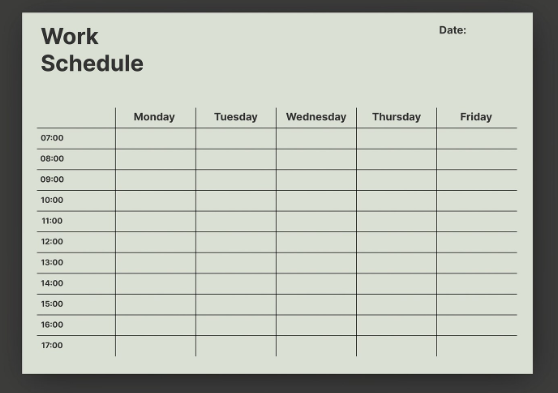
Manual timesheets fail in three specific ways that are particularly pronounced in Malaysian workplace contexts.
Memory compression makes recent days more visible than earlier ones
Ask any employee to reconstruct their working hours for the past month, and the pattern is predictable.
They remember last week with reasonable accuracy, the week before with moderate accuracy, and estimate the two weeks before that based on what feels typical. The result is a timesheet that accurately reflects the last seven days and approximates the other 23.
This memory compression is not dishonesty. It’s how human memory works. But it means that the timesheet submitted on the 30th is a partial record at best, one that systematically underweights unusual hours from earlier in the month and overweights the pattern of the most recent week.
For Malaysian businesses, accurate working hours records are critical for project billing, client reporting, and Employment Act compliance. This compression creates financial and legal exposure that often goes unnoticed.
Social dynamics create systematic over-reporting
Malaysian workplace culture places significant value on being seen as hardworking and committed. This creates a subtle but consistent pressure on manual timesheets: employees who worked exactly their contracted hours sometimes round up slightly to avoid appearing to have done the minimum. Employees who left early on a slow day may not record the early departure. Employees who took longer breaks may not reflect this in their logged hours.
None of this is dramatic falsification. It’s small adjustments that accumulate across a team of 20 over 12 months into a material discrepancy between recorded hours and actual hours, such as 15 minutes here and half an hour there. Employee digital timesheets remove the social dynamic entirely by relying on verified clock-in and clock-out data instead of self-reporting.
Version control chaos in multi-location or hybrid teams
A Malaysian F&B chain with 4 outlets running timesheets in Excel has 4 different files, possibly in 4 different formats, collected by 4 different people with 4 different interpretations of what counts as overtime. The HR manager consolidating these at month end is not working with a payroll record. They’re working with 4 separate estimates that need to be reconciled into one.
The same problem occurs in hybrid teams where remote employees submit digital documents while office-based employees use paper. Different collection methods produce different data qualities, and the payroll team absorbs the reconciliation burden every single month.
Also read: Sales Geofencing Malaysia to Prevent Fake Check-ins
How Employee Digital Timesheets Work and Why They’re Different

The fundamental difference between manual and digital timesheets is not the format. It’s the source.
A manual timesheet is self-reported, an employee constructs it from memory. An employee digital timesheet generates itself from verified activity data. GPS confirms location, facial recognition verifies identity, and overtime approvals are submitted and timestamped in advance.
Here’s the flow that produces a digital timesheet automatically.
An employee arrives at a clinic in Bangsar at 8.52 am. They clock in through the mobile attendance app. GPS geofencing confirms they’re within the approved zone. Facial recognition confirms their identity.
The system logs the employee ID, timestamp, location, and verification status.
- At 1.05 pm they clock out for a break.
- At 1.38 pm they return and clock back in.
- At 6.15 pm they clock out for the day.
- Total verified working time: 8 hours 50 minutes.
That record doesn’t need to be submitted, approved, or summarised. It exists, timestamped and verified, the moment it happens.
At month end, the timesheet reflects 30 days of verified records like this. The payroll manager doesn’t receive an estimate. They receive a document built from verified events, one that they can trace back to specific timestamps if any entry is ever questioned.
In practice, employee digital timesheets don’t change the format of the document. They change the reliability of the data underneath it.
Also read: Best Shift Scheduling Software for SEA Operations Teams
What Employee Digital Timesheets Solve for Malaysian Businesses

Here are concrete problems that manual timesheets create, and that digital timesheets resolve.
Payroll accuracy without month-end reconstruction
Manual timesheet payroll depends on the accuracy of what employees submit and the diligence of whoever reviews it. Digital timesheet payroll depends on verified records captured throughout the month. For Malaysian businesses paying shift premiums, overtime multipliers, and public holiday rates, the difference between estimated and verified hours directly affects payroll cost.
A retail chain in Johor Bahru with 20 staff paying an average of RM12 per hour has a payroll exposure of RM12 per undetected hour discrepancy per employee. Across 20 employees with modest timesheet estimation errors, for example 30 minutes per day on average, that’s RM1,440 per month in unverifiable payroll cost. Automated timesheets eliminate the estimation layer, and payroll is based on numbers the business can actually verify.
Project billing and client reporting that reflects actual hours
Malaysian professional services firms, such as law firms, architecture practices, marketing agencies, IT consultancies, bill clients based on hours worked. When those hours come from employee self-reporting, billing accuracy depends entirely on how carefully each employee tracked their time during the engagement.
Digital timesheets for remote teams in professional services contexts capture accurate records at task or project level. They give firms the data they need to bill confidently and the audit trail to defend those figures if clients question them.
Employment Act compliance without additional administrative effort
Malaysia’s Employment Act requires employers to maintain records of working hours, overtime, and breaks. These records must be available for inspection and retained for specific periods. Manual timesheets satisfy this requirement technically but fail it practically. When a Labour Department inspector requests records, manually filled timesheets based on memory do not carry the same credibility as timestamped digital records.
Working hours tracking through digital systems provides records that are both legally compliant and operationally credible, without requiring anyone to spend additional time creating documentation. The compliance record is the operational record.
Also read: Multi-Site Attendance Tracking Software for HR Teams in SEA
Employee Digital Timesheets Across Different Malaysian Industries

Timesheet accuracy means different things in different industries. Here’s how employee digital timesheets address the specific working hours challenges in common Malaysian SME contexts.
F&B and hospitality
Malaysian F&B businesses run tight margins where labour cost is the most variable and most controllable expense. Shift-based scheduling means payroll depends on accurately tracking which employee worked which shift, including shift premiums for weekend and public holiday work. Digital timesheets built from shift clock-ins give F&B owners accurate labour cost data by shift, by day, and by employee, without requiring anyone to record it.
The break tracking component is particularly valuable. A 30 staff meal break that consistently runs 45 minutes adds up across a team of 15 over a month. Digital timesheet apps that track break start and break end separately from shift clock-in and clock-out give owners visibility into this pattern without requiring manual monitoring.
Healthcare and clinic operations
Private clinics and healthcare practices in Malaysia operate with complex staffing structures: doctors, nurses, medical assistants, and administrative staff on different schedules and pay structures. Accurate working hours tracking across these staff categories is essential for payroll accuracy and for the credibility of claims submitted to insurance and regulatory bodies.
Digital timesheets for clinic groups provide verified records of each staff category’s working hours, including overtime for extended consultation sessions or emergency coverage. The facial recognition verification layer is particularly important in healthcare contexts where staff identity confirmation matters for both operational and regulatory reasons.
Construction and site-based operations
Malaysian construction businesses manage site workers across multiple project locations with variable daily schedules. Traditional timesheet management at construction sites involves paper records that are frequently incomplete, damaged, or disputed. Cloud timesheet software that works on mobile devices and functions offline gives construction managers verified records of site attendance and working hours from locations where desktop access is impossible.
Professional services and agencies
Creative agencies, IT consultancies, and professional services firms in Kuala Lumpur and Penang bill clients by the hour and need accurate time records to support those invoices. Digital timesheets that track time at project or task level rather than just total daily hours give professional services firms the granularity they need for accurate billing without requiring employees to manually log every activity throughout the day.
How Hadirr’s Employee Digital Timesheets Work for Malaysian Teams
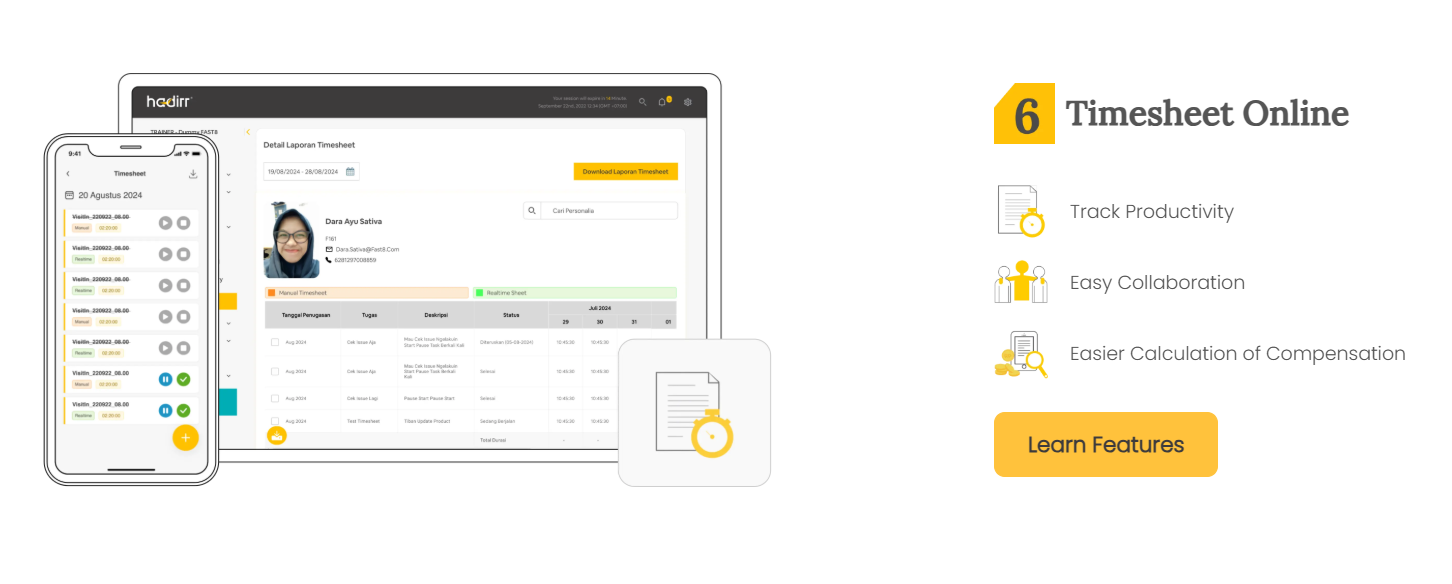
Here are questions every Malaysian business owner should be able to answer instantly, and whether their current timesheet system lets them.
“How many hours did Kumar work last Tuesday, including his break and the overtime he claimed?”
With a manual timesheet, this question requires finding Kumar’s submission, hoping he logged Tuesday separately from his weekly total, and cross-referencing it against whatever overtime approval record exists, if one exists at all.
With Hadirr’s timesheet online, the answer is one click. Tuesday’s record shows: clock-in at 8.47 am, break from 1.02 pm to 1.34 pm, clock-out at 7.15 pm, overtime of 1 hour 15 minutes approved by the branch manager at 5.30 pm with a digital approval timestamp. The timesheet didn’t need to be submitted. It is based on Kumar’s verified attendance record and his approved overtime.
“Is Farah’s overtime this month within the Employment Act cap?”
With a manual timesheet, answering this requires adding up Farah’s submitted overtime across the month, assuming she submitted it accurately and completely.
With Hadirr’s attendance system connected to the overtime tracking, Farah’s accumulated overtime is visible in real time throughout the month, not just at month end. If she’s approaching the 104-hour monthly cap, her manager should not request or approve additional overtime.
The timesheet records every approved overtime session with a timestamp and approver identity, giving the payroll manager a complete, auditable trail without any additional compilation effort.
“What did our total labour hours look like across all locations last month?”
With manual timesheets consolidated at branch level, answering this requires collecting submissions from every location, reconciling different formats, and manually aggregating the totals. In a Malaysian business with 4 locations, this typically takes 2 to 3 days.
With Hadirr’s cloud-based timesheet system, the consolidated report is built automatically across all locations. Every clock-in from every branch, whether it’s a retail outlet in Subang Jaya or a service centre in Johor Bahru, flows into the same verified dataset. The total labour hours report is available the moment the month closes, in a format that payroll can process and management can act on.
The Timesheet That Writes Itself

Manual timesheets will always be inaccurate. That’s not a criticism of the people filling them in. It’s an acknowledgement of how memory works and how workplace social dynamics operate. Employee digital timesheets don’t ask people to be more precise. They remove the estimation requirement entirely.
The gap between a timesheet compiled from memory and one generated from verified clock-in data is the difference between something that might be right and something that can be proven right.
The right digital timesheet doesn’t add work. It removes the monthly reconstruction exercise that consumes HR bandwidth, introduces payroll errors, and creates compliance exposure, replacing it with a document that already exists, verified and complete, the moment the month closes.
Replace estimates with evidence. See what a timesheet looks like when it comes directly from verified working hours data with Hadirr.