
Productivity Software Malaysia: Monitor Your Team in Real Time
Many businesses searching for productivity software Malaysia solutions are not struggling with attendance, they are struggling with visibility. The team looks busy. Calendars are full. WhatsApp groups stay active all day. But when the month closes and management reviews what actually moved forward, such as client visits completed, sales opportunities progressed, and projects delivered, the results often do not match the level of activity.
This gap between visible busyness and measurable productivity is one of the most common and least-discussed operational challenges in Malaysian businesses today. It is not always a motivation problem. In many cases, it is a visibility problem. Managers can see that employees are working, but they cannot clearly verify what work was completed, where it happened, or how consistently it progressed throughout the month.
That is why productivity software has evolved beyond simple attendance tracking. Malaysian businesses increasingly need systems that provide real-time visibility into tasks, field activity, client visits, working hours, and team performance, without relying entirely on manual reports that are often delayed, incomplete, or difficult to verify.
How Malaysian Businesses Actually Measure Productivity

Productivity is easy to define in theory and surprisingly difficult to measure in day-to-day operations.
Most Malaysian businesses still rely on indirect indicators: attendance records that confirm presence, timesheets that log hours, and activity reports that summarise what employees say they completed. These records are useful, but they don’t provide a clear picture of actual productivity.
Real productivity visibility answers a more meaningful set of questions.
- Not just “was Najib in the office today?” but “what did Najib complete during those eight hours?”
- Not just “how many client visits did the sales team report this week?” but “which visits resulted in follow-up actions, proposals, or pipeline movement?”
- Not just “how many overtime hours were logged?” but “did those extra hours improve output, or were they caused by inefficient scheduling?”
The productivity software Malaysia businesses increasingly rely on connects these operational signals into one system: attendance records, timesheets, field activity logs, project updates, and sales movement. It allows managers to see how employee time translates into measurable business results.
Businesses that get this right do not necessarily have employees who work harder. They have better visibility into where productive effort is happening, where time is being wasted, and which operational areas need improvement.
Also read: Field Sales Software for Malaysian SMEs: Stop Guessing, Start Tracking
Where Productivity Software Works in Malaysian Businesses

Productivity visibility problems look different depending on how a team operates. In Malaysia, there are three business contexts where generic productivity tools often fail to provide meaningful insight.
Office teams: where presence is mistaken for productivity
Office-based teams are usually the easiest to monitor physically and the hardest to evaluate operationally. Employees are present. Attendance is recorded. Working hours are logged. But what actually happened during those hours often remains unclear without constant follow-ups from managers, such as which tasks were completed, which meetings led to decisions, and which projects moved forward.
For office teams, the productivity software Malaysia businesses need should connect attendance and timesheet records to task progress and activity tracking. The goal is not just to confirm that employees were present for eight hours, but to understand what those eight hours produced.
Field teams: where work happens outside management visibility
Field teams create a different challenge entirely. Sales representatives, technicians, healthcare workers, and delivery staff spend most of their working hours outside the office, beyond direct managerial oversight. Productivity depends on whether field activities actually happen as scheduled, at the right locations, with the right clients, and with proper documentation.
Without live monitoring, field productivity becomes whatever employees report at the end of the day. With GPS-verified tracking and live activity dashboards, managers can see field operations as they happen instead of reconstructing them afterward.
Sales teams: where pipeline movement matters more than activity volume
Sales productivity is not measured by how busy a sales rep appears. It is measured by whether opportunities move forward.
A sales rep who makes 50 calls but advances no deals creates activity without meaningful output. A rep who conducts 20 client visits, documents each interaction properly, and moves prospects through the pipeline creates measurable business progress.
For sales organisations, the employee productivity tracking managers need should connect field activity directly to pipeline movement, showing how sales actions contribute to revenue outcomes, not just how much activity occurred.
Also read: Best CRM Software in Malaysia for SMEs (2026 Guide)
What Malaysian Businesses Actually Need from Productivity Software

Five questions separate productivity software that genuinely improves business performance from software that simply generates reports without improving outcomes.
Can it show what the team is doing right now, not what they reported yesterday?
Up-to-date productivity visibility is what makes management actionable. Reports delivered at the end of the day or end of the week only describe situations after they have already happened. By then, missed opportunities, delays, or operational problems may already be affecting the business.
The productivity software Malaysia businesses need should provide immediate visibility into team activity, allowing managers to intervene, redirect priorities, or provide support before issues escalate.
Does it capture activity automatically or depend on self-reporting?
Self-reported activity data is only as reliable as employee memory and consistency. End-of-day reporting often creates incomplete records, especially for fast-moving teams handling multiple tasks or client visits.
Productivity software that captures activity automatically, through GPS-verified attendance, timestamped visits, digital task logs, or system-generated timesheets, creates records based on what actually happened instead of what employees remember later.
Does it connect employee activity to business outcomes?
Hours worked and visits completed are operational inputs. Revenue generated, deals progressed, projects delivered, and customer issues resolved are business outcomes.
The right work activity tracking software connects these layers together. Managers should be able to see not only what the team did, but also whether those activities produced measurable results for the business.
Does it support mobile and field teams, not just office staff?
Most Malaysian businesses manage distributed workforces. Sales representatives, branch employees, technicians, healthcare workers, and hybrid teams spend significant time outside traditional office environments.
Productivity software designed only for desk-based employees fails to capture much of where operational productivity actually happens. Mobile accessibility, GPS verification, and real-time field tracking are no longer optional features for Malaysian businesses managing distributed teams.
Is it simple enough for the entire team to adopt?
Even the most advanced productivity platform fails if employees avoid using it. For Malaysian SMEs, implementation often happens while day-to-day operations continue running, making usability critical.
The best productivity software Malaysia businesses can implement is software employees can learn quickly, managers can monitor easily, and owners can operate without adding unnecessary administrative complexity.
Also read: How to Track Field Sales in Malaysia Without Violating PDPA
How Hadirr Works as Productivity Software for Malaysian Teams

Hadirr’s positioning as productivity software for Malaysian teams reflects a simple operational logic: you cannot manage what you cannot see, and you cannot see productivity clearly unless attendance, field activity, working hours, and sales pipeline all live in the same system.
Here’s how the layers connect, from the first activity of the day to the management insight at month end.
Layer 1: Attendance, the productivity foundation
Every working day starts with a verified clock-in. Hadirr’s attendance system uses GPS geofencing and facial recognition to confirm that the right person is at the right location at the right time. For office teams in Kuala Lumpur, this means a verified start time. For field teams in Johor or Penang, this means confirmed presence at the assigned location, whether that’s a client site, a branch office, or a project location.
This isn’t just attendance management. It’s the first data point in a day’s productivity record, establishing when productive time began, where it began, and who it belongs to.
Layer 2: Shift and working hours, the time structure
Centralised shift scheduling connects roster management to attendance records. Managers see not just who is present, but whether the right people are covering the right shifts. For Malaysian SMEs running morning and afternoon shifts across multiple locations, this layer answers the question every operations manager asks first: is the team structured correctly for today’s workload?
Overtime management adds the cost visibility layer, routing every overtime request through a documented approval workflow and surfacing accumulated hours in real time. When overtime consistently concentrates in certain locations or roles, that pattern becomes a productivity signal: something in the workflow is creating hours that shouldn’t be necessary.
Layer 3: Timesheets, the working hours record
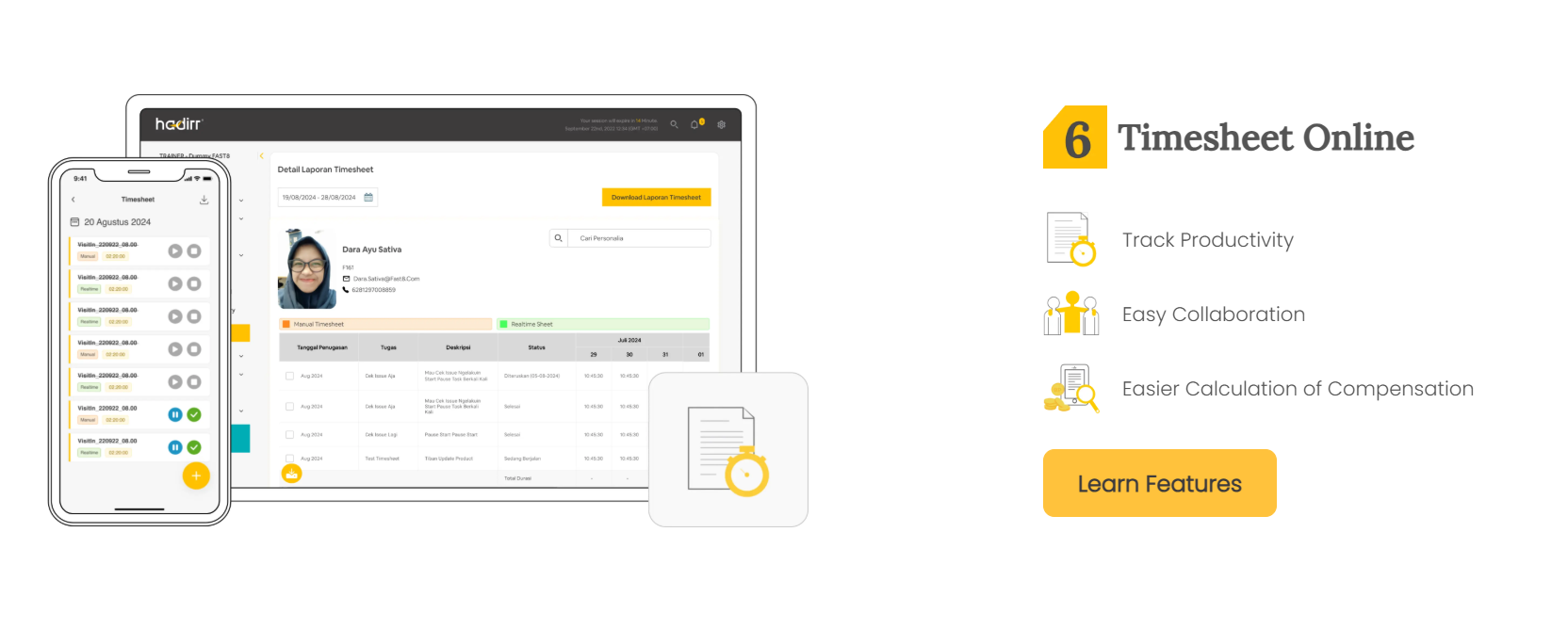
Hadirr’s online timesheet is generated automatically from verified attendance, approved overtime, and break records. There is no manual compilation. There is no month-end reconstruction. The timesheet exists as a byproduct of the team simply doing their work through the system: accurate, complete, and audit-ready.
For Malaysian businesses where payroll accuracy and Employment Act compliance depend on working hours records, this automation removes administrative burden while improving data quality. The timesheet that once took two days to prepare now exists before anyone asks for it.
Layer 4: Field activity, where productivity becomes visible
For field and sales teams, client visit tracking captures what happens between clock-in and clock-out. GPS verification confirms the visit location. Digital signatures confirm client engagement. Meeting notes and follow-up actions create a structured record of what occurred. Visit duration timestamps show how long productive engagement lasted.
This layer transforms field team management from assumption-based to evidence-based. The question “did the team visit the right clients today?” moves from something managers have to ask to something the system answers automatically in real time, with verified documentation.
Layer 5: Sales pipeline, the productivity outcome
Hadirr connects field activity to commercial outcomes. Client visits feed directly into pipeline stages of CRM. Deal progression is tracked against activity. Managers see which reps are generating pipeline movement and which are generating activity without commercial traction.
This is where productivity software for Malaysia’s sales-led businesses shows its value most clearly. Not just “how many visits did the team make?” but “which visits moved deals forward?” The connection between activity and outcome becomes visible instead of being inferred from separate systems that never fully align.
From activity to insight: the unified view
When these five layers operate together in one system, the productivity picture that emerges is fundamentally different from what any single tool can produce. A manager opening Hadirr’s dashboard on a Tuesday afternoon can immediately see: who is present across all locations, which shifts are fully covered, which field visits have been completed versus planned, where the sales pipeline stands against targets, and whether overtime is accumulating in ways that require attention.
That visibility is what productivity software for Malaysian teams should actually deliver: real-time, cross-functional, and built from verified data rather than self-reported summaries.
Also read: Stop Client-Site Fraud with Geofencing Client Solutions in Malaysia
Why Malaysian Businesses Choose Hadirr

There are four reasons that go beyond feature lists, reflecting the realities of managing teams in Malaysia.
Built for mobile workforces, not desk-based assumptions
Malaysian businesses manage distributed teams: field sales reps, multi-branch staff, hybrid workers, and remote employees. Hadirr’s mobile-first architecture means the entire platform works from a phone in Kota Kinabalu as smoothly as it works from a desktop in Kuala Lumpur. Offline capability also helps maintain data integrity in areas with unreliable connectivity.
Designed with PDPA compliance in mind
Malaysia’s Personal Data Protection Act 2024 amendments classify GPS location data and facial recognition as personal data requiring explicit consent and proportionate processing. Hadirr’s consent workflows, time-limited tracking, and role-based data access are structured around these requirements, helping businesses improve productivity visibility without creating unnecessary regulatory exposure.
One integrated system instead of disconnected tools
Many Malaysian SMEs still manage productivity using separate systems: one for attendance, another for timesheets, a third for sales tracking, and WhatsApp for everything else. Hadirr brings these functions into one connected platform where data flows automatically across departments and workflows. This reduces the manual reconciliation work that often consumes HR and management time every month.
Priced for Malaysian SMEs, not enterprise budgets
Productivity software Malaysia SMEs can sustain financially must deliver operational value at realistic price points. Hadirr’s pricing scales with team size, suitable for a 10-person retail outlet and practical for a 100-person field sales operation. The free trial also gives businesses a chance to evaluate the fit before making a commitment.
More than 10,000 companies across Southeast Asia, including F&B chains, retail networks, clinic groups, logistics businesses, and sales organisations, use Hadirr to manage teams that work from offices, from the field, and from everywhere in between.
Also read: Multi-Site Attendance Tracking Software for HR Teams in SEA
Productivity Visibility Drives Better Performance
The Malaysian businesses that consistently improve team performance share one operational advantage: they can see what their teams are actually doing, in real time, with enough detail to make decisions before opportunities pass or problems escalate.
That visibility doesn’t come from working harder or hiring more carefully. It comes from using productivity software Malaysia managers can rely on to connect attendance, working hours, field activity, and sales outcomes in one system, creating a clear view of how the team’s time translates into business results.
The gap between a busy team and a productive one is often a visibility gap. The right software helps close it.
See what your team is actually producing. Try Hadirr and give your business the productivity visibility it needs to improve performance with confidence.